When I retired as a humanist celebrant I thought I'd stop writing this blog, but my fascination with all things death-related prompted more posts. They're just written from a slightly different perspective, that's all. Oh, and I still do the odd one, by special request.

Tuesday, August 18, 2026

What are vigils for?

 Just days after the death of Cambridge professor Jason Arday,  apparently by suicide, a huge crowd met in Trafalgar Square to hold a vigil in his memory.

If I was bereaved in a similar fashion, would I want someone I loved commemorated in this way? No, absolutely not.

Vigils seem to have become popular over the last couple of decades. People are invited to attend by word of mouth and social media. There was one for murder victim Sarah Everard, during which the police got involved because it was in defiance of the social distancing rules due to COVID. 

I've been told that it means people are showing respect, but why?

On reflecion, it seems to be a newly fashionable expression  of recreational mourning. 

Jason attracted the wrong sort of attention during his life and now it seems to me he's attracting the wrong sort in his death.


Wednesday, August 02, 2023

A peaceful death

 Actor Richard E Grant's account of the death of his wife Joan is lovely. She died at home, with him beside her, holding her hand, after he noticed it getting colder. His description of those last few moments of life will be familiar to many. Noise or fuss shouldn't intrude.

It's the sort of death that most of us wish for, when our time comes.

Read or listen to it here.

Tuesday, July 06, 2021

Pronouns

There's currently a craze for preferred pronouns, which means that people who've adopted a gender identity expect others to refer to them by pronouns other than the usual ones. I wasn't called upon to conduct a funeral for anybody like that, fortunately, but what they and other people may not have considered is that you've no control about what other people say about you in your absence, alive or dead.

Sunday, May 16, 2021

Names

A couple of posts ago I mentioned that I was going to write about dead-naming. So I am, but first, a bit about names in general.

I was named after my maternal grandmother, who died when I was still very young, so I don't remember much about her. I do remember that my mother loved her very much and that she'd be hurt if she thought that I didn't like my name or I'd changed it. But I'm happy with it and have kept it. It would be difficult to get used to a different one. If I'd been given a name like one of the weird ones given by some American parents, I might have thought differently.

Like many other people, I've changed my surname, and like many other people, I changed it back again. My sister changed her surname twice, the first time when she married and the second time when she divorced. She also changed her forename because after her divorce she wanted a whole new life. That's not entirely possible, unless you move away and abandon your old life and all the people in it. You might do it if you were in witness protection, of course.

According to gender identity lore, there are two cardinal sins. The first is misgendering someone, or referring to them using the pronouns appropriate for their sex, which is different from their gender, which is an assumed characteristic or affectation. The second is dead-naming someone, which means using the name they had before they decided to transition from one gender to another. It's considered worse then a faux pas to accidentally use the former name of someone who's done this, apparently. 

We write our own life stories. My memory is rather moth-eaten, but others may remind me of things I've forgotten or something will pop up. Some memories may be shared when family and friends gather to mark my death, assuming they do. When your flesh and blood is gone, memories persist. If you've had children, others may recognise familiar characteristics in them.

We've no control over what other people remember about us. When we die they'll think of the parts of our lives that we shared with them, good or bad. So whatever you call yourself, the person behind the name will still be there. You can no more erase the part of your life you shared with other people than you can erase your essential existence as a woman or a man. Your name won't be dead, just unused, except by other people who might forget, or not know.

So, the moral of this post, and I'm sorry but there is one, is that trying to control other people's thoughts or memories is the stuff of Orwellian nightmares, and no one is likely to remember you kindly. Your epitaph may reflect this.

Saturday, May 15, 2021

Morbid? Me?

A friend who lives miles away emails often, expecting replies promptly, the way people used to write letters every day when the post was a primary means of communication. I understand that she's lonely, but hope that one a week might suffice. I've tried phoning, but she never answers. Anyway, in a recent email she wrote, "Yes, I do think it's a morbid interest of yours, your interest in death. Rather depressing too, to say the least!". I could imagine her holding her nose. She'd asked what I'd been reading, and I'd answered that I don't often read fiction and had bought Caitlin Doughty's book, 'Smoke Gets In Your Eyes, and other lessons from the crematorium', which I looked forward to reading. I replied to her comment:

My interest in death and dying relates to the work I did for over twenty years conducting funerals and meeting hundreds of interesting people that I interviewed about their relatives. I heard some very interesting life stories and a lot of social history. The youngest person I did a funeral for was a stillborn baby - that was sad - and the oldest was over a hundred. I met some lovely people in the funeral trade who are kind, caring and sometimes very funny. When you're doing a job like that you need to be able to laugh sometimes. So no, it's not morbid and it's not depressing, though sometimes sad. I wouldn't have done it if it depressed me. I'm also interested in the social history of death, and in poetry and other writing about bereavement.

I think my interest in death was first piqued by a book that's now out of print about the Hunter Brothers, who were pioneering surgeons in 18th century London. One of them did some extraordinary dissections, which I saw on a visit to the Royal College of Surgeons Museum when I was an art student. We were taken there by our anatomy teacher, a retired surgeon. I believe the collection is now in The Wellcome Collection.
Don't suppose that'll change her mind about my morbid interest.

Wednesday, March 27, 2019

My 15 minutes of fame, and what it was about

If liberty means anything at all, it means the right to tell people what they do not want to hear.
George Orwell 
A post I wrote over a year ago, Death doesn't misgender. You die as you were born, attracted the ire of transgender activists who'd presumably found it through my Twitter profile while they were taking exception to what I'd written there. On February 4th I had a phone call from a woman police officer who told me there'd been complaints about the blog post and some tweets, including one that read "Gender is BS". During a brief conversation we established that I'd done nothing illegal and had no intention of self-censoring to avoid upsetting whoever had complained, and we left it at that. Then I tweeted about it, and things went mad. Fellow gender critics shared my tweet, which attracted a lot more followers (from a couple of hundred to over four thousand), and I had another phone call, this time from James Kirkup, who writes for The Spectator, among other publications. He wrote about it. Subsequently the story was shared in various other newspapers, in the UK and abroad, and in podcasts and on ITV regional news. And it was all because of a very brief, non-threatening phone call. The publicity resulted in a call from a Detective Chief Superintendent, who rang to apologise and tell me that they'd "got it wrong". I've seen no reason to tweet any differently since then, and several people, including a professional pathologist, agreed that my blog post was entirely accurate; you do die as the same sex as you were born.

I got off lightly. Some police forces appear to have had "training", which is more like indoctrination, from organisations who give the impression that they're experts, but aren't. They're pressure groups staffed by people without any appropriate professional qualifications. West Yorkshire, Humberside, Liverpool and Sussex police have all had visits from these people. Some have apparently been motivated by a small minority of transgender officers, maybe even only one or two. Consequently they've acted as conduits for complaints from trans activists who spend a lot of time trawling through the Internet on the lookout for anything to complain about. As the law on so-called hate crime is rather woolly it's relatively easy to make an allegation of "causing distress" - one of the indications of a "hate incident" - and they do. So while I was let off with the suggestion that I might be more careful, in other words not upset anyone, others haven't been so fortunate. Death threats have been made, as well as complaints.

One benefit of the hoo-ha, as far as I'm concerned, is that I've met some lovely people online, feminists and allies, who mostly have a healthy sense of humour and of the ridiculous as well as being angry about the absurdity. It's struck me that transgender activists seem to lack a sense of humour and are generally unhappy people, which is sad.

I was going to write about transgenderism and what's wrong with it on my other blog, but no point in that when others have done so much better than I. A comprehensive account by Helen Joyce is one of the best. It's a long read, but worth it.

My next post here will be about dead-naming, as I thought it appropriate in a blog about death. Watch this space.

Wednesday, June 20, 2018

Jemima

There are broken bits of commemorative stonework lying around the village church walls. It's sad to see memorials for those who died young but even sadder to see that whatever was left of someone has ended up as a weed suppressant. Who was she?

Monday, June 18, 2018

Body snatchers, and how they were thwarted

Mortsafe in Towie churchyard, Aberdeenshire
Before the Anatomy Act of 1832, trainee doctors and surgeons relied on body-snatchers to supply them with corpses for dissection. This was at a time when many people believed that you wouldn't be allowed into heaven if your body wasn't intact, so the thought of their loved ones' remains being desecrated horrified them. This photo is from an interesting article about the lengths that some people went to, to prevent the bodies of their newly dead loved ones from being stolen. When a body had rotted, it was of little interest to the anatomists, so was left in peace.

My body may be of use to the trainee doctors at Cambridge University, so I've bequeathed it to them. You can do the same - see the link on the right.

Monday, April 09, 2018

Wise words about the process of dying

Dr Mannix explains what happens.
When the video appeared on Facebook someone commented "Hardly comforting to hear this. Death is traumatic at every level - and always will be." Sad to hear someone feels this way but I suppose it's quite common. When someone's killed in traumatic circumstances, such as being horribly injured in a war, obviously that's different, but "always will be" just isn't true.

Sure Dr Mannix would approve of this quote:
Perhaps the best cure for the fear of death is to reflect that life has a beginning as well as an end. There was a time when we were not: this gives us no concern—why then should it trouble us that a time will come when we shall cease to be? . . . To die is only to be as we were before we were born; yet no one feels any remorse, or regret, or repugnance, in contemplating this last idea. It is rather a relief and disburthening of the mind: it seems to have been holiday-time with us then: we were not called upon to appear upon the stage of life, to wear robes or tatters, to laugh or cry, be hooted or applauded; we had lain perdus all this while, snug, out of harm’s way; and had slept out our thousands of centuries without wanting to be waked up; at peace and free from care, in a long nonage, in a sleep deeper and calmer than that of infancy, wrapped in the finest and softest dust.  And the worst that we dread is, after a short, fretful, feverish being, after vain hopes, and idle fears, to sink to final repose again, and forget the troubled dream of life!
On the Fear of Death, William Hazlitt, 1778-1830.

Friday, January 19, 2018

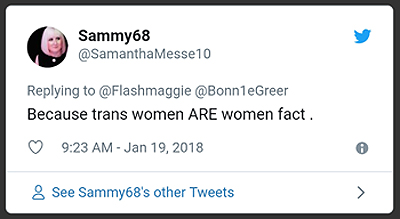
Death doesn't misgender. You die as you were born.


In a discussion (if you can call it that) about transgenderism and the proposed changes to the Gender Recognition Act on Twitter, the tweet above was aimed at me. It'll be familiar to those of you who question the claim, since it's been repeated umpteen times by irritable transgender people and their chums. According to them, anyone who dares to question the assertion that you can change your sex, whether from male to female or female to male, is a "transphobe", or we "misgender" people, or worse. These absurd beliefs are nonsensical and deny all the evidence to the contrary.

When I die my body should be sent to the teacher of anatomy at The University of Cambridge, as it's been bequeathed for medical education. For how to donate your body, see the link on the right. I wrote should be sent, as it may not be accepted if they have a glut of cadavers or if it's not in good enough condition. The medical students who dissect my body will discover that I was a woman, as I have female anatomy, minus a couple of bits. I have no uterus, as it was removed years ago, and only one breast, as I've had a mastectomy. But there will be no doubt that it was a female body.

If a transgender person's body was dissected, either for medical education or a post-mortem examination, his or her sex would also be obvious to a student or pathologist. Not the sex that he or she chose to present as, but his or her natal sex; the sex that he or she was born with. Even when a body has been buried for a very long time, so that there is no soft tissue left, only bone, it is still possible to identify the sex. DNA and characteristics such as the shape of the pelvis will be clear proof of the sex of the corpse. Any surgery that had been intended to make someone appear different from his or her biological sex, the sex they were born with, will make no difference. It will still be obvious. There is a very small number of people who are described as intersex, because their anatomy isn't typical of a male or female, but their existence doesn't validate the claim that a man can be a woman or vice versa. They are very different from transgender people. So no, in life or in death, trans women are not women, no matter how many times you say it's so. It's simply impossible to change your sex.

Gender is different. Gender roles are determined by convention, culture, tradition, the family, and a whole bunch of other variables. It's not so much what sex you were born with as where you were born, the society you were raised in, and how independent you are or are allowed to be. In countries like ours, Great Britain, we have more freedom to follow our interests and express ourselves as we please. In other countries, such as the Islamic theocracies, unconventional people risk punishment or even death. So transgender people are fortunate if they live in relatively liberal societies. They can express themselves as they please. But this doesn't mean that claiming to be what you're not is any more ethical, or that it's ethical to claim rights that disadvantage others, such as women's hard-won rights. We are entitled to our safe spaces, to representation in women's organisations, including political ones, to prizes and awards specifically for women, and to compete on equal terms in athletics and sports where male physical strength and size would put us at a disadvantage. And there are very good reasons why there are separate prisons for men or women, and no good reasons to change this.

So, in conclusion, you die as you were born, whichever sex that was. That's a fact.

If the skeleton in the image was a real skeleton, and it could be properly examined, you could tell if it was male or female, though Christians generally assume that the Angel of Death is male, like their God. Jadzia Dax wouldn't have made this sort of fuss.

Update, 2/10/19
It's now possible to determine the sex of a skeleton from its tooth enamel. The Lovers of Modena,  who died about 1,500 years ago, have been identified as men, not a heterosexual couple.

Update, 29/5/2021
Sara Dahlen, MSc Student, Bioethics and Society, King's College, London, to the BMJ, on the importance of knowing a patient’s sex before medical treatment:
"If an unknown patient comes in to A&E, unaccompanied and unconscious, their gender identity would not be ascertainable. However, their sex would remain observable, and would make a difference to that patient’s care."
Thursday, December 28, 2017

You just never know when you'll go...

Lucius Annaeus Seneca, known as Seneca the Younger, who lived in Rome from about 4 BC to AD 65, wrote about the fear of death:
No one is so ignorant as not to know that he must die one day … You will go where all things go … This happened to your father, your mother, your ancestors, everyone who came before you; it will happen to everyone who comes after you. A succession that is never broken and which no power can change has bound all things and draws them all together … did you not imagine that you yourself would not at some time arrive at that point to which you were always travelling? There is no journey without an ending.
My mum died of a cerebral haemorrhage on Christmas Eve 1990, minutes after demonstrating to some children at a Christmas party that she could still kick her own height at the age of seventy-seven. It was six months after my dad died of cancer, ending a year's suffering, and Mum had declared that she didn't want to go like him, so she got her wish, though it was a shock for us. I've known people react with disbelief when a relative died at Christmas, spoiling their holiday, but death doesn't care.

There are some lessons about life and death from the obituaries in the Canadian publication, MacLean's by Michael Friscolanti. He wrote that he learned:
Find love, if possible, and follow that love wherever it leads. Be yourself, whoever that is. When the bell tolls, money really does mean nothing. The reaper doesn’t accept bribes. Don’t feel sorry for yourself (and if you must, keep it short). 
This is just a summary - click on the link for more.

None of us knows how long we've got, so Carpe Diem folks, and Happy New Year. Oh, and to save any confusion, make a will.

Wednesday, April 05, 2017

How will you die?

Just read a report about another celebrity who's "sadly died". Sadly dying, rather than just dying, is a clichéd way to go. I'd prefer to die without elaboration. Someone on Twitter suggested they just use this.

Monday, August 29, 2016

High rise cemetery

This is the Memorial Necrópole Ecumênica in Santos, Brazil, a mausoleum housing thousands of bodies. I suppose that buildings like "the world's tallest cemetery" might appeal to planners in places where burial space is limited or unavailable, but I can't see British local authorities approving them, even if they were only a few storeys high. Can you imagine the fuss from the nimbys?

Bodies placed into crypts above ground decompose in a small space, releasing fluids and gases. If they're not properly sealed they can explode, as has happened. It's been described as a "clean and dry" way to dispose of the dead, but it's anything but. It's certainly not environmentally-friendly and won't appeal to those who want to be returned to Nature, as a corpse buried in the ground is. It's ironic that the crypts in this building facing a pleasant view of the surrounding hills attract a higher price, while no one is encouraged to think about the reality of the process. Yuk. No thanks.

Click here to see a short film about the building.

Thursday, July 28, 2016

Death from a scientific point of view


A friend died not long ago. He wasn't a close friend, and I only met him face to face two or three times, but he was the sort of person you don't forget in a hurry, mainly because of his paradoxical character; outwardly a misanthrope but a generous, loving person in disguise. Over the last few years, Simon collected many friends via social media, mainly through Twitter and Facebook, and many of them socialised with him in real life, not just online. His Facebook page is still there and his closest friends are still sharing memories through it. Today I found that one had written a blog post mentioning him and quoting something that made sense to a heathen like me. Simon would have liked it too, as the confirmed atheist that he was. It's by Aaron Freeman, who broadcasts with America's NPR radio station.
You want a physicist to speak at your funeral. You want the physicist to talk to your grieving family about the conservation of energy, so they will understand that your energy has not died. You want the physicist to remind your sobbing mother about the first law of thermodynamics; that no energy gets created in the universe, and none is destroyed. You want your mother to know that all your energy, every vibration, every Btu of heat, every wave of every particle that was her beloved child remains with her in this world. You want the physicist to tell your weeping father that amid energies of the cosmos, you gave as good as you got.

And at one point you’d hope that the physicist would step down from the pulpit and walk to your brokenhearted spouse there in the pew and tell him/her that all the photons that ever bounced off your face, all the particles whose paths were interrupted by your smile, by the touch of your hair, hundreds of trillions of particles, have raced off like children, their ways forever changed by you. And as your widow rocks in the arms of a loving family, may the physicist let him/her know that all the photons that bounced from you were gathered in the particle detectors that are her/his eyes, that those photons created within her/him constellations of electromagnetically charged neurons whose energy will go on forever.

And the physicist will remind the congregation of how much of all our energy is given off as heat. There may be a few fanning themselves with their programs as he says it. And he will tell them that the warmth that flowed through you in life is still here, still part of all that we are, even as we who mourn continue the heat of our own lives.

And you’ll want the physicist to explain to those who loved you that they need not have faith; indeed, they should not have faith. Let them know that they can measure, that scientists have measured precisely the conservation of energy and found it accurate, verifiable and consistent across space and time. You can hope your family will examine the evidence and satisfy themselves that the science is sound and that they’ll be comforted to know your energy’s still around. According to the law of the conservation of energy, not a bit of you is gone; you’re just less orderly.

© 2005, NPR.org
You can hear Freeman read this if you click here.

There have been others who've pointed out that nothing ever disappears completely, and that the stuff we are made of is recycled, including the 17th century French orator, Jacques-Bénigne Bossuet:
All things summon us to death: nature, almost envious of the good she has given us, tells us often and gives us notice that she cannot for long allow us that scrap of matter she has lent. . . she has need of it for other forms, she claims it back for other works.
Bossuet was a bishop and a theologian, so Simon might not have approved of me quoting him, but even bishops have been known to talk sense.

Friday, July 01, 2016

The ways of God are strange!

57,000 casualties were sustained on the first day of the battle
It's the 100th anniversary of The Battle of the Somme today. The event at The Thiepval Memorial in France shown on TV was moving but although it included a reading from Sassoon and stressed the loss of so many ordinary working men, it didn't make any reference to the cynicism of some soldiers, the desertions, the suicides and the minds wrecked by what we now call "post-traumatic stress disorder", which was then called "shell shock". Yes, there are many tales of heroism under fire, but what about all the other stories?
They

The Bishop tells us: 'When the boys come back
They will not be the same; for they'll have fought
In a just cause: they lead the last attack
On Anti-Christ; their comrades' blood has bought
New right to breed an honourable race,
They have challenged Death and dared him face to face.'

'We're none of us the same!' the boys reply.
'For George lost both his legs; and Bill's stone blind;
Poor Jim's shot through the lungs and like to die;
And Bert's gone syphilitic: you'll not find
A chap who's served that hasn't found some change.'
And the Bishop said: 'The ways of God are strange!'

Siegfried Sassoon, 1916

Wednesday, May 25, 2016

Just passing by

In all the years that I've written funeral scripts, I've never used the euphemism "passed away" rather than "died". Apart from a feeling that it's religious, suggesting that you're going to end up somewhere else, like heaven, rather than simply being dead, I've never been convinced that it makes things any easier for the bereaved to accept their loss. I've read that it's supposed to be a "gentler" term than saying that someone's died. No one's complained about it, or suggested that I should say something different. Rather, I've sensed a sense of relief that I haven't used that sort of language.

The term is being used by journalists in news reports. I find it as irritating as the common reference to anyone dying of cancer as having "lost the battle" or "fighting" their illness. As has been said by various people with cancer, including me, you don't die of it because you didn't try hard enough.

I read that funeral directors have noticed the term being used more often since about the 1970s. If that's true I suspect that it's due to a general reluctance to accept the reality of death and the consequent pain of loss. Some people seem to regard grief as a form of mental illness that should be treated with pharmaceuticals, rather than a natural reaction to losing someone you've loved. Pain, of any sort, shouldn't happen, they seem to think, and using "gentle" euphemisms might help to avoid too much of it. Except that it doesn't work. You've no control over grief. Suppressing it will make you ill.

One of my favourite journalists is Michael Goldfarb, who wrote on Facebook,
When did the verb “to die” and the nouns derived from it—dead, death, etcetera — get excised from American usage to be replaced by “to pass.”

Wind gets passed. I hereby authorize all 500 plus of my Facebook friends to say of me, when the moment comes, that “Michael died, is dead, his death was a tragedy,” etcetera.  Please don’t say, “I’ve passed.” If you need a euphemism, say “I’ve shuffled,” as in shuffled off this mortal coil.
"Wind gets passed" - I like that. One day I'll die. I won't be passing anywhere except, probably, the dissection room at Cambridge medical school before they dispose of what's left of me in a suitably hygienic manner. 

Image: 'The Last Dream', a monument by J. Edwards to the Late Miss Hutton of Sowber Hill near Northallerton. Nice to see that she changed into her nightie before passing away.

Thursday, May 12, 2016

Wisdom


Found on the web - source unknown
.

Wednesday, March 23, 2016

Flowers and candles - what good do they do?

Floral tributes near the Bataclan concert hall in Paris 
The latest terrorist attack in Belgium has had various reactions, from predictable shock and horror, especially from those directly affected, to crowds gathered to assert their defiance against Daesh's threats. In Belgium and in Paris, and earlier in London, some have left flowers, hand-written messages and lit candles to express their sympathy with the families and friends of the dead and injured. As a friend in the funeral trade once observed, these public expressions of sympathy seemed to begin with the Hillsborough disaster in 1989, when fans left their club scarves and other tributes on the gates of the stadium. Now almost every tragic death, from single road accident victims to multiple murder victims, seems to be marked with an assortment of objects; flowers, soft toys, candles, and more. It's become conventional to do this, so that if a tragedy doesn't attract a roadside pile of stuff, you might be forgiven for thinking that no one cared about it. Since 2006, Twitter has enabled messages of sympathy to be posted online; the Internet equivalent of flowers and candles.

Who benefits from all this? Isn't it enough to feel sorry for those affected, without feeling obliged to demonstrate it in some way? Does it make any difference to those who are bereaved? Maybe. Maybe not. I can't help feeling that it's like a kind of emotional blackmail. If you don't join the throng, you don't care? That's plainly not true. Is it something that will gradually fade away, just as the rotting flowers do? Will all the little metal cups that held the candles float away in the rain, and the sentiment they expressed go back to where it began, in the minds of those who cared?

In today's Guardian, Anne Perkins suggests that when terror strikes, you might consider doing something useful.
The urge to solidarity is a very powerful one. It’s why humans are such a successful species. But at some point the genuine if emotional gesture can teeter over into something else altogether. It becomes another version of exhibitionism. It stops being motivated by an outward-looking desire to demonstrate collective resistance and slides into the self-absorbed projection of the individual into whatever event of the day is shocking or enthralling.
Express your sympathy by giving blood, or donate money to the Red Cross or the air ambulance that ferries the injured to hospital. If all the money that was spent on flowers, candles and cuddly toys was donated to organisations that help people affected by disaster, they'd be a lot better off.

Picture: Steve Parsons/PA Wire/Press Association Images

Tuesday, March 15, 2016

On ending up as litter when you're dead


I've previously written about how scattering ashes (otherwise known as "cremains") qualifies as litter. It's tricky, because bereaved people get understandably upset if thwarted when trying to mark a loss with soggy teddy bears, plastic flowers, wind-chimes and so on. They're likely to get even more upset if you try to tell them that scattering Mum's ashes on a favourite walk isn't such a good idea. To some people, bereavement seems to mean a licence to do as you please, no matter what the consequences.

Another form of litter spread by bereaved people is the floating kind - balloons and sky lanterns. Both of these are a menace. Balloons can end up anywhere and many fall into rivers or the sea, where they're ingested by birds and mammals, killing them. Sky lanterns can cause fires (and have done) and the frameworks can kill livestock if accidentally eaten. Some farmers report the loss of very valuable animals.

I was reminded of all of this today while watching Griff Rhys Jones on TV, talking about a volunteer who spends a lot of his time on the top of Snowden, clearing up litter. People leave plastic bottles, fag ends, chewing gum, and all sorts of rubbish up there. They also leave human ashes, oblivious to the damage they cause. Ashes affect the ecology of the mountain. As Jones pointed out, they're not the same as the rocks; they're more fertile. Meanwhile, the mountain rangers report that, some days, they go up there and it looks like a dusting of frost, there are so many ashes lying about. The plastic flowers that are sometimes left with them are totally inappropriate. As Griff says, "Snowdon is not a public memorial in the sky."

If you were thinking of suggesting to your nearest and dearest that you'd like your ashes scattered where you used to enjoy all those lovely family picnics, think again. They can bury them under a tree (one that they've bought to plant for the purpose, and with permission) or keep them in a jar. Anything, in fact, except litter with them.

Friday, January 01, 2016