Generalised statements, like "Have the British forgotten how to grieve?", are meaningless. There is no collectively British way to grieve, and never was, though there have been socially acceptable rituals surrounding death for millennia. The two shouldn't be confused. Clover seems to be going through a list of options, in search of some sort of structured grieving process. There isn't one, though some people may find comfort in sharing rituals because they don't need to think about them; you just follow a prescribed formula, which is an easy option when you're emotionally fragile.
As someone who's been bereaved several times, in different ways, and as a humanist celebrant for over 20 years, my experience has been that grief is personal and everyone grieves according to their own personality and the relationship that they had with the person (or pet) who died. A mother who'd lost her baby once asked me, "How long will I feel like this?", as though there should be a time limit to it, or desperately hoping that the pain would end soon. Some self-styled grief counsellors used to tell clients that there are stages to grieving, to be followed in order. This is nonsense. Months, years after a loss, something may remind you of the one you loved and the feelings may return, perhaps less acutely, but still in a wave of emotion. No one has forgotten how to grieve; we just can't help ourselves.
Showing posts with label mourning. Show all posts
Showing posts with label mourning. Show all posts
Friday, February 21, 2014
Grief and mourning rituals are two different things
A Telegraph sub-editor has headed an article about grieving by Clover Stroud, "Have the British Forgotten how to grieve?" I've commented:


Saturday, March 16, 2013
A wound that never heals

As I've said at funerals, we might accept the death of an old person who's lived a long and full life, though we still grieve for him or her, but it's different when we lose a young person. I've said it while remaining necessarily detached from the waves of emotion coming from the mourners, the parents and siblings, the families and friends, of the baby or child who's died. One distraught mother asked me, during my interview, "When will I stop feeling like this?" I couldn't answer that.
On Red Nose Day I saw the faces of the celebrities visiting hospitals in Africa where babies were dying from preventable diseases, like malaria, and from complications due to malnutrition, and from pneumonia, and they were all visibly moved. How could they not be? Could you imagine losing not one, but more than one of your children like that? So much grief, then having to carry those poor little bodies home, wrapped in a cloth, on public transport. Can you imagine having to do that?
Today one of my Twitter contacts posted a link to an article in the Guardian, a terrible story about how the 2004 tsunami hit a family on holiday in Sri Lanka. Sonali Deraniyagala has found the words to describe losing her two young sons. She found the words; many others share the pain. It's not the sort of thing that you can just drop into a conversation with strangers. That's the thing about grief; other people are oblivious to yours, and you are to theirs.
I think I also don't confess because I am still so unbelieving of what happened. I am still aghast. I stun myself each time I retell the truth to myself, let alone to someone else. So I am evasive in order to spare myself. I imagine saying those words – "My family, they are all dead, in an instant they vanished" – and I reel.Take care of the people you love and never take them for granted; you don't know what might happen, and how much you'd regret it if you hadn't.
-----------oOo-----------
A simple Child,
That lightly draws its breath,
And feels its life in every limb,
What should it know of death?
from ‘We Are Seven’ by William Wordsworth
Photograph: a memorial headstone for children in The Old Cemetery, Ipswich
Friday, November 30, 2007
The end is nigh
 Why write about the death of a pet? Because some of us mourn for them just as we mourn for people.
Poppy is eighteen years old. She was given to me as a pathetic little scrap that had been born in a coal bunker. The mother's owner wouldn't have her cats neutered and when they had kittens she just took them to the vets and asked them to kill them. My cleaner, who was a neighbour of this stupid person, phoned me and said would I take a couple of kittens she'd rescued, until she could rehome them? Someone took the other kitten before she got to me, or I could have ended up with both of them.
Poppy was filthy. She survived having a tape worm, fleas, lice and ear mites. By the time we'd nursed her back to health, Nathan said he didn't want to part with her. She's been run over (her tail was paralysed for about six weeks), had skin cancer (part of an ear had to be amputated), came home one day with a puncture wound in her face, and went missing for a couple of months about two years ago. The photo above, taken not long ago, has been viewed 248 times (to date) and favourited 44 times by cat-lovers on Flickr.com.
Poppy has a sunny disposition, she loves company, and liked to sit beside any visitors and pat them on the arm until they stroked her. Now she's dying. Within the next few weeks, I'll have to make the decision to take her to the vet one last time. Her kidneys are failing and her breath has that tell-tale smell of urine. She sleeps a lot.
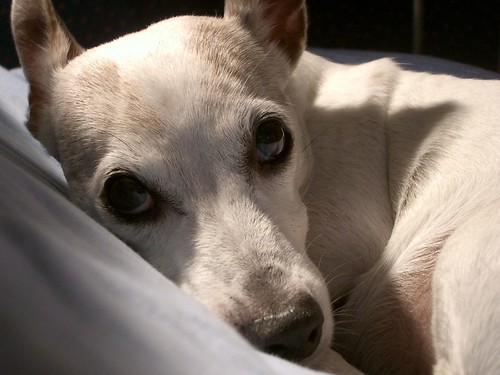
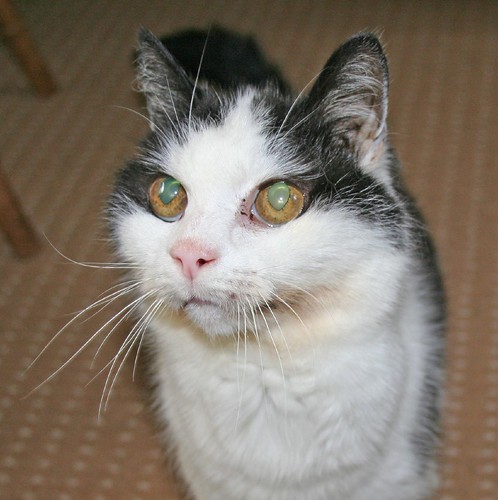 Trouble is, there are two other geriatrics in this house - Wizzy (our Jack Russell), who was sixteen in May, and Barney, who's almost twenty. Before long, I'll lose them all.
Pets are sometimes referred to as "companion animals", which is an accurate description. For many people, particularly disabled and elderly people, they provide companionship that makes all the difference between crippling loneliness and tolerable solitude. Losing a pet can be as devastating for them as losing a close relative - in some cases, more so. I've provided a befriending service for bereaved pet owners through our local vet. They've said they found it hard to talk about their feelings to their friends, whose attitude might be, "It was only a dog!" Their uncomprehending "friends" muddle sentimentalism with grieving. Because pet owners can form bonds with their animals that can be as close as they might form with people, they grieve at the end of an animal's short life; those who don't recognise this betray their own deficiencies. When I was in my teens, my best friend's mum, Stella, gave me some good advice about relationships: "If he doesn't like animals or children, he's a waste of time." I've always regarded people who don't understand animals, or our relationship with them, as being seriously lacking in the empathy department.
For several years now, social workers have recognised that there's often a connection between animal abuse and child abuse; if someone tortures or neglects an animal, he or she is likely to treat his or her children (and partner) badly. Animal cruelty cases can alert social workers to children at risk. It's because of an inability to empathise.
I've always stayed with my pets when they've been "put to sleep", the euphemism for euthanasia, so they'd be reassured by my presence. After the injection, which literally does send them to sleep, they just stop breathing and that's it, over in seconds. It's always been very peaceful. If only we could do the same for people, like my dad, who had to suffer weeks of morphine-induced anxiety at the end of his life as his body rotted away. I've taken other people's pets to the vet because they couldn't face it. Within the next few weeks, I'll have to take Poppy. I'm not looking forward to it.
I like this poem by Gavin Ewart, called "A 14-year-old convalescent cat in the winter" -
I want him to have another living summer,
to lie in the sun and enjoy the douceur de vivre -
because the sun, like the golden rum in a rummer,
is what makes an idle cat un tout petit peu ivre -I want him to lie stretched out, contented,
revelling in the heat, his fur all dry and warm,
an Old Age Pensioner, retired, resented
by no one, and happinesses in a bee-like swarmto settle on him - postponed for another season
that last fated hateful journey to the vet
from which there is no return (and age the reason),
which must come soon - as I cannot forget.
Postscript:
Nathan's reminded me about how different attitudes towards dogs and cats are in countries like Cambodia. He mentioned that someone in Siem Reap had a row with his neighbour, who'd killed and eaten his dog "because he was hungry", while other people in the neighbourhood had pulled out or cut out their dogs' teeth to stop them biting each other during frequent fights - the screams could be heard some distance away. The WSPA reports that there are roughly 480 million stray dogs around the world, many suffering from horrible diseases and painful deaths. My pets live in comparative luxury, costing £1000s for food and vet's bills. Is it ethical to spend so much money on our animals, when so many people go hungry? Perhaps it's not so much the cost, as the fact that too many animals are allowed to breed. Mine weren't.
Monday, November 27, 2006
Widow
 I collect old photographs. This postcard was in a batch I've just bought from a dealer over the Internet. It appears to be a woman wearing mourning dress, though I've never seen this type of bonnet and veil before.
On the back of the card the dealer's written "early Edwardian", and there's a photographer's stamp; "Copyright - Lizzie Caswell Smith, 90 Gt. Russell Street, WC1".
Lizzie Caswell Smith is listed in the National Portrait Gallery's collections, but none of her photographs are shown online. Will have to check the next time I go there.
Friday, September 02, 2005
Mourning sickness
Rosie Boycott, former editor of The Independent, made a TV programme about false grief for Channel Five, shown last week. I was practically cheering when I saw it. In 2002 a Welsh academic, Dr James Thomas, claimed that 'the majority did not mourn for Diana', as the conclusion to his research. Think-tank Civitas published a report in February 2004, claiming that a vocal minority indulge in 'recreational mourning'. It's all very unhealthy. It's also very annoying, because the media, including the BBC, will insist on referring to 'a nation in mourning', or 'a city in mourning', such as when Iraq hostage Ken Bigley was murdered, whenever there's been a tragedy like this. Excuse me - but who asked the 'nation' or the 'city' whether we really were in mourning for someone we never knew? One particularly shocking result of the hysteria over Diana's death was the huge amount of money spent on flowers by members of the public, left to rot in the streets, together with soggy teddy bears and pathetic love notes. More than a million bouquets were left at Kensington Palace, her home. Multiply that by the cost of an average bouquet, and you can see that London florists made a lot of money around the time of the funeral. Imagine how that money could have been used by some cash-strapped charitable organisations, including the ones that Diana supported, such for landmine victims, or AIDS patients.
On the day of Princess Diana's funeral I conducted a wedding ceremony in a small hotel in Suffolk. The couple had been expected to cancel their wedding by some of their silliest friends, although the arrangements had been made for months. They asked me if I thought they should, as they didn't want to appear heartless and uncaring, which they emphatically were not. I said no, they should go ahead. It was strange, driving to the venue, because the roads were so quiet. Hotel guests were glued to the telly in the lounge next door to the wedding room, watching the funeral. They cast disapproving glances in our direction as we trooped through to the reception in the garden. Bloomin' cheek! Only weeks before, the tabloid press had been depicting Diana as a floozy, out gallivanting with her 'boyfriend', the Fayed playboy. Now they were making out she was some sort of saint.
A year after the death, I did a Thought for the Day on local radio, as follows:
A Story from the Telegraph:
On the day of Princess Diana's funeral I conducted a wedding ceremony in a small hotel in Suffolk. The couple had been expected to cancel their wedding by some of their silliest friends, although the arrangements had been made for months. They asked me if I thought they should, as they didn't want to appear heartless and uncaring, which they emphatically were not. I said no, they should go ahead. It was strange, driving to the venue, because the roads were so quiet. Hotel guests were glued to the telly in the lounge next door to the wedding room, watching the funeral. They cast disapproving glances in our direction as we trooped through to the reception in the garden. Bloomin' cheek! Only weeks before, the tabloid press had been depicting Diana as a floozy, out gallivanting with her 'boyfriend', the Fayed playboy. Now they were making out she was some sort of saint.
A year after the death, I did a Thought for the Day on local radio, as follows:
I didn't mourn the death of Diana, nor did many other people. How could we? It was all such a waste, and very sad for her family, but we didn't know her. Grief is personal.
Throughout history, humankind has mourned its dead in a variety of ways in accord with the customs of the community. It's different now. Things are less clear. The media, especially television, is a huge influence. There is a lot of confusion. People seem to want to be told what to do, as though there's an etiquette of mourning. Perhaps this is one of the reasons why so many people behaved the way they did a year ago, when crowds lined the streets of London around the palaces and along the route of the funeral procession. Maybe for a few hours those people felt a sense of community, otherwise missing from their lives.
A year ago I was on Radio Suffolk talking about the news of Diana's death with Rachel (the presenter). I said that many people seemed to have lost a sense of proportion. I saw Rachel wince, anticipating a backlash from enraged listeners, but the only calls we had were from people who said they agreed with me but hadn't liked to say so. I resented the way that those of us who didn't identify with the 'we' the commentators kept talking about were discouraged from saying anything at all, even from saying that we felt it was all a bit excessive. Too many people made a virtue out of weeping for Diana. Weeping for her was something you did or didn't do, but no one should have been made to feel that if they had no tears they should apologise for it.
Grief, the genuine article, affects everyone differently. Some go quiet. Some weep. Some get angry. Some want to be alone. Some want to be with others. Some do all these things. The situation changes daily. Grief affects us emotionally and physically. Some people, bereaved for the first time, are shocked by how little control they have over it. If you loved someone, even if you didn't always like him or her, grief is the very natural consequence of losing them. And it's personal - —very, very personal.
So if you feel there must be something wrong with you because you haven’t been swept away on a tide of popular emotion, I can assure you there isn't. Many other people feel like you, but just don't like to say so. As Shakespeare wrote:
... to thine own self be true,
And it must follow as the night the day,
Thou canst not then be false to any man.
25 October - update
A Story from the Telegraph:
A passer-by saw what he or she thought was a dead human foetus in a Liverpool alleyway, and after a few days the area was cluttered with the usual soggy teddy bears, dead flowers and mawkish messages. It turned out to be a dead chicken, the police said yesterday, not a human being.
Subscribe to:
Posts (Atom)