When I retired as a humanist celebrant I thought I'd stop writing this blog, but my fascination with all things death-related prompted more posts. They're just written from a slightly different perspective, that's all. Oh, and I still do the odd one, by special request.
Showing posts with label dead pets. Show all posts

Friday, March 08, 2013

On preserving the wrong sort of memories

Important people who died in foreign parts used to be taken home for burial stuffed into a barrel of something alcoholic. In 1805, Admiral Nelson's body was brought home in a barrel of brandy. In hot climates, bodies are either buried as soon as possible, before they start to stink (the origin of the contemporary funeral practices for Jews and Muslims), or they might be embalmed, if the body is to be viewed. Embalming is less common in the UK than the US, where open coffins are favoured. These are short term solutions to the problem of putrefaction, when scented handkerchiefs don't do the trick. The long term preservation of a body is another matter.

Channel 4's newsman Jon Snow has written a cautionary post in his blog about the plan to preserve the body of President Hugo Chavez of Venezuela, referring to the embalming of Kenya's President Kenyatta and the USSR's Lenin, who's been gradually crumbling over the years:
Lenin has suffered considerably down the years. An ear fell off some time ago and had to be re-attached. Nasty black splodges appear on his skin from time to time and have to be removed with hydrogen peroxide.
Poor Fido! Must have
been much better
looking before he died.
Not how Lenin probably expected to be remembered - a mouldering heap - and an example of how not to preserve the dead. If you're really keen to be kept around in some semblance of your living appearance, you could elect to be stuffed or plasticised. As I don't expect to look very attractive when I kick the bucket, I wouldn't want to inflict the sight of my corpse on anyone for longer than necessary, and in any case, some medical students will have a better use for it.


Stuffed dog from a collection of examples of what happens when taxidermy goes wrong.

Thursday, January 22, 2009

Cremains

In 1874, Sir Henry Thompson, Bart., FRCS, Surgeon to Queen Victoria, founded the Cremation Society of Great Britain, having written, "it was becoming a necessary sanitary precaution against the propagation of disease among a population daily growing larger in relation to the area it occupied". Municipal cemeteries were filling fast, and cremation was introduced to deal with the problem of disposal. It wasn't popular with the church to begin with, maybe because it associated the fire of the furnace with the fires of hell, but as the practice gained popularity with the general public, the clergy changed its tune.

I believe that we British cremated more of our dead than any other nation apart from the Japanese, who don't have a lot of space for internments. This is probably still true. I think most people prefer cremation to burial because it's all done behind closed doors and they don't have to deal with the messy aspects of disposal, like mud and earth. But as the population's increased, funerals have become more elaborate, and a majority of families choose to remove cremains (which are bone fragments, ground up) from crematoria, instead of leaving them to be buried or scattered in the "gardens of rest", the country's being liberally dusted with bone meal. It might do some plants good (though blood and bone meal used to attract our dogs' attention), but it's not the sort of stuff you want to scatter everywhere, willy-nilly.

When a close relative died the other year, her ashes were divided up between several people and places. I'm not sure how many portions there were, but one lot was scattered in Cornwall, another in Norfolk, and there's a little pot sitting on a shelf at home because I haven't done anything with it. It was suggested that because she enjoyed sitting in my garden, I could scatter my portion there. I don't know how the ashes were divided; whether they were weighed in equal portions or if it was a guestimate. It's irrational, I know, but I don't like the idea of dividing people up like this. It doesn't matter to her, of course, but why spread her about like that? I didn't ask for a share but hadn't the heart to refuse. Once upon a time, people dreaded being cut up or otherwise divided, for fear of being denied access to heaven without all their parts. That's not how I feel, but it still seems unnecessarily fussy to mess about with people's ashes.

Like most people, I never used to give the matter much thought. It's become popular to scatter ashes, whether all at once or in portions, in places associated with the dead person. I suppose it's quite romantic, to imagine that he or she will become a part of a place that he or she liked, or where something special happened. But it's irrational, as most of our reactions to death are, and so many people are doing it that it's causing a pollution problem, and is being restricted. I can imagine some bereaved people, determined to ignore restrictions, shuffling around beauty spots with ashes dribbling from the bottom of their trousers, like the men in The Great Escape who had to get rid of the earth from their tunnels without the guards seeing them.

A retired RAF officer I know told me about an airman who requested that his ashes be scattered from the cockpit of a plane. Apparently they blew straight in again and had to swept up with a dustpan and brush when the plane landed.

The lover of a woman who died years ago had to keep his loss a secret, as he was a married Catholic and his family knew nothing about the affair. For almost a year after the woman died, he used to write to me about her, as he had no one else he could talk to. He showed me photos of a secluded place in the Suffolk countryside where they used to meet, and where he scattered her ashes, so he could "feel close to her". After a year, he wrote that he thought he could manage, and I never heard from him again. I wonder how often he visited the spot where he'd left her, and whether it stayed as he remembered it, or if it had been sold to a developer and was covered with semi-detached houses - or, worse still, industrial units.

As an increasing proportion of the population becomes obese, cremators that can cope with big bodies are in demand. Fat people from our area have had to be taken miles away for cremation because none of the local cremators are big enough. Then there's the problem of mercury pollution, from tooth fillings. A new building to house equipment that will deal with such pollutants is being planned for our local crematorium where it will take up a hefty proportion of the car park, which is already too small.

One way or another, the disposal of cremated remains is becoming a problem as serious as the one that cremation was designed to solve. It'll be a long time before it's sorted, mainly because there's a general aversion to discussing anything to do with death. Try applying for planning permission for a green burial site, and you'll see what I mean.

If they'll have it, my body's going to the anatomists, who'll bury what's left when they've finished with me. As for my relative's ashes; I'm going to fork her into the flower border in the spring, safe in the knowledge that, since the dog died last summer, she's less likely to be dug up again. As for the dog; her ashes are in a little box, next to her photo and her collar. You see, I said we're irrational about death.
Friday, November 30, 2007

The end is nigh

Why write about the death of a pet? Because some of us mourn for them just as we mourn for people.

Poppy is eighteen years old. She was given to me as a pathetic little scrap that had been born in a coal bunker. The mother's owner wouldn't have her cats neutered and when they had kittens she just took them to the vets and asked them to kill them. My cleaner, who was a neighbour of this stupid person, phoned me and said would I take a couple of kittens she'd rescued, until she could rehome them? Someone took the other kitten before she got to me, or I could have ended up with both of them.

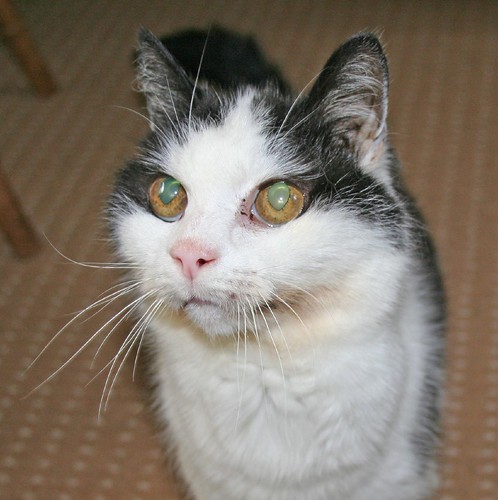
Poppy was filthy. She survived having a tape worm, fleas, lice and ear mites. By the time we'd nursed her back to health, Nathan said he didn't want to part with her. She's been run over (her tail was paralysed for about six weeks), had skin cancer (part of an ear had to be amputated), came home one day with a puncture wound in her face, and went missing for a couple of months about two years ago. The photo above, taken not long ago, has been viewed 248 times (to date) and favourited 44 times by cat-lovers on Flickr.com.

Poppy has a sunny disposition, she loves company, and liked to sit beside any visitors and pat them on the arm until they stroked her. Now she's dying. Within the next few weeks, I'll have to make the decision to take her to the vet one last time. Her kidneys are failing and her breath has that tell-tale smell of urine. She sleeps a lot.

Trouble is, there are two other geriatrics in this house - Wizzy (our Jack Russell), who was sixteen in May, and Barney, who's almost twenty. Before long, I'll lose them all.

Pets are sometimes referred to as "companion animals", which is an accurate description. For many people, particularly disabled and elderly people, they provide companionship that makes all the difference between crippling loneliness and tolerable solitude. Losing a pet can be as devastating for them as losing a close relative - in some cases, more so. I've provided a befriending service for bereaved pet owners through our local vet. They've said they found it hard to talk about their feelings to their friends, whose attitude might be, "It was only a dog!" Their uncomprehending "friends" muddle sentimentalism with grieving. Because pet owners can form bonds with their animals that can be as close as they might form with people, they grieve at the end of an animal's short life; those who don't recognise this betray their own deficiencies. When I was in my teens, my best friend's mum, Stella, gave me some good advice about relationships: "If he doesn't like animals or children, he's a waste of time." I've always regarded people who don't understand animals, or our relationship with them, as being seriously lacking in the empathy department.

For several years now, social workers have recognised that there's often a connection between animal abuse and child abuse; if someone tortures or neglects an animal, he or she is likely to treat his or her children (and partner) badly. Animal cruelty cases can alert social workers to children at risk. It's because of an inability to empathise.

I've always stayed with my pets when they've been "put to sleep", the euphemism for euthanasia, so they'd be reassured by my presence. After the injection, which literally does send them to sleep, they just stop breathing and that's it, over in seconds. It's always been very peaceful. If only we could do the same for people, like my dad, who had to suffer weeks of morphine-induced anxiety at the end of his life as his body rotted away. I've taken other people's pets to the vet because they couldn't face it. Within the next few weeks, I'll have to take Poppy. I'm not looking forward to it.

I like this poem by Gavin Ewart, called "A 14-year-old convalescent cat in the winter" -

I want him to have another living summer,
to lie in the sun and enjoy the douceur de vivre -
because the sun, like the golden rum in a rummer,
is what makes an idle cat un tout petit peu ivre -

I want him to lie stretched out, contented,
revelling in the heat, his fur all dry and warm,
an Old Age Pensioner, retired, resented
by no one, and happinesses in a bee-like swarm

to settle on him - postponed for another season
that last fated hateful journey to the vet
from which there is no return (and age the reason),
which must come soon - as I cannot forget.

Postscript:

Nathan's reminded me about how different attitudes towards dogs and cats are in countries like Cambodia. He mentioned that someone in Siem Reap had a row with his neighbour, who'd killed and eaten his dog "because he was hungry", while other people in the neighbourhood had pulled out or cut out their dogs' teeth to stop them biting each other during frequent fights - the screams could be heard some distance away. The WSPA reports that there are roughly 480 million stray dogs around the world, many suffering from horrible diseases and painful deaths. My pets live in comparative luxury, costing £1000s for food and vet's bills. Is it ethical to spend so much money on our animals, when so many people go hungry? Perhaps it's not so much the cost, as the fact that too many animals are allowed to breed. Mine weren't.

Saturday, September 02, 2006

Over the Rainbow Bridge

It’s bad enough when people get yuckily sentimental over dead friends and relatives, often the same friends and relatives they used to ignore or whinge about while they were alive, but when they start going into yuck overdrive over a dead pet, I give up.

No, I’m not a heartless bitch who can’t understand it when people grieve over a dog or cat – I’ve done it, and will again – but there are limits.

Since friend Jan announced the death of a much-loved cat on Flickr, I’ve discovered the ‘Rainbow Bridge’ group. What’s a Rainbow Bridge? You may well ask. It’s what dead pet owners will cross with their dead pets on their way to Heaven, apparently.

The Rainbow Bridge Flickr group quotes an anonymous author (doubtless he or she was too ashamed of the rubbish he or she had written to actually put a name to it), who describes how old, sick and injured pets are made whole again…
They all run and play together, but the day comes when one suddenly stops and looks into the distance. His bright eyes are intent. His eager body quivers. Suddenly he begins to run from the group, flying over the green grass, his legs carrying him faster and faster.

You have been spotted, and when you and your special friend finally meet, you cling together in joyous reunion, never to be parted again. The happy kisses rain upon your face; your hands again caress the beloved head, and you look once more into the trusting eyes of your pet, so long gone from your life but never absent from your heart.

Then you cross Rainbow Bridge together...
Then what? You spend Eternity stuck there, playing the same games over and over until you’re fed up with throwing balls and stroking heads? The trouble with most people’s idea of an afterlife is that they haven’t thought of the consequences. Boredom, for one thing...