When I retired as a humanist celebrant I thought I'd stop writing this blog, but my fascination with all things death-related prompted more posts. They're just written from a slightly different perspective, that's all. Oh, and I still do the odd one, by special request.
Showing posts with label death. Show all posts

Wednesday, March 27, 2019

My 15 minutes of fame, and what it was about

If liberty means anything at all, it means the right to tell people what they do not want to hear.
George Orwell 
A post I wrote over a year ago, Death doesn't misgender. You die as you were born, attracted the ire of transgender activists who'd presumably found it through my Twitter profile while they were taking exception to what I'd written there. On February 4th I had a phone call from a woman police officer who told me there'd been complaints about the blog post and some tweets, including one that read "Gender is BS". During a brief conversation we established that I'd done nothing illegal and had no intention of self-censoring to avoid upsetting whoever had complained, and we left it at that. Then I tweeted about it, and things went mad. Fellow gender critics shared my tweet, which attracted a lot more followers (from a couple of hundred to over four thousand), and I had another phone call, this time from James Kirkup, who writes for The Spectator, among other publications. He wrote about it. Subsequently the story was shared in various other newspapers, in the UK and abroad, and in podcasts and on ITV regional news. And it was all because of a very brief, non-threatening phone call. The publicity resulted in a call from a Detective Chief Superintendent, who rang to apologise and tell me that they'd "got it wrong". I've seen no reason to tweet any differently since then, and several people, including a professional pathologist, agreed that my blog post was entirely accurate; you do die as the same sex as you were born.

I got off lightly. Some police forces appear to have had "training", which is more like indoctrination, from organisations who give the impression that they're experts, but aren't. They're pressure groups staffed by people without any appropriate professional qualifications. West Yorkshire, Humberside, Liverpool and Sussex police have all had visits from these people. Some have apparently been motivated by a small minority of transgender officers, maybe even only one or two. Consequently they've acted as conduits for complaints from trans activists who spend a lot of time trawling through the Internet on the lookout for anything to complain about. As the law on so-called hate crime is rather woolly it's relatively easy to make an allegation of "causing distress" - one of the indications of a "hate incident" - and they do. So while I was let off with the suggestion that I might be more careful, in other words not upset anyone, others haven't been so fortunate. Death threats have been made, as well as complaints.

One benefit of the hoo-ha, as far as I'm concerned, is that I've met some lovely people online, feminists and allies, who mostly have a healthy sense of humour and of the ridiculous as well as being angry about the absurdity. It's struck me that transgender activists seem to lack a sense of humour and are generally unhappy people, which is sad.

I was going to write about transgenderism and what's wrong with it on my other blog, but no point in that when others have done so much better than I. A comprehensive account by Helen Joyce is one of the best. It's a long read, but worth it.

My next post here will be about dead-naming, as I thought it appropriate in a blog about death. Watch this space.

Monday, April 09, 2018

Wise words about the process of dying

Dr Mannix explains what happens.
When the video appeared on Facebook someone commented "Hardly comforting to hear this. Death is traumatic at every level - and always will be." Sad to hear someone feels this way but I suppose it's quite common. When someone's killed in traumatic circumstances, such as being horribly injured in a war, obviously that's different, but "always will be" just isn't true.

Sure Dr Mannix would approve of this quote:
Perhaps the best cure for the fear of death is to reflect that life has a beginning as well as an end. There was a time when we were not: this gives us no concern—why then should it trouble us that a time will come when we shall cease to be? . . . To die is only to be as we were before we were born; yet no one feels any remorse, or regret, or repugnance, in contemplating this last idea. It is rather a relief and disburthening of the mind: it seems to have been holiday-time with us then: we were not called upon to appear upon the stage of life, to wear robes or tatters, to laugh or cry, be hooted or applauded; we had lain perdus all this while, snug, out of harm’s way; and had slept out our thousands of centuries without wanting to be waked up; at peace and free from care, in a long nonage, in a sleep deeper and calmer than that of infancy, wrapped in the finest and softest dust.  And the worst that we dread is, after a short, fretful, feverish being, after vain hopes, and idle fears, to sink to final repose again, and forget the troubled dream of life!
On the Fear of Death, William Hazlitt, 1778-1830.

Friday, January 19, 2018

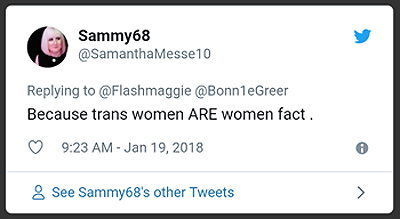
Death doesn't misgender. You die as you were born.


In a discussion (if you can call it that) about transgenderism and the proposed changes to the Gender Recognition Act on Twitter, the tweet above was aimed at me. It'll be familiar to those of you who question the claim, since it's been repeated umpteen times by irritable transgender people and their chums. According to them, anyone who dares to question the assertion that you can change your sex, whether from male to female or female to male, is a "transphobe", or we "misgender" people, or worse. These absurd beliefs are nonsensical and deny all the evidence to the contrary.

When I die my body should be sent to the teacher of anatomy at The University of Cambridge, as it's been bequeathed for medical education. For how to donate your body, see the link on the right. I wrote should be sent, as it may not be accepted if they have a glut of cadavers or if it's not in good enough condition. The medical students who dissect my body will discover that I was a woman, as I have female anatomy, minus a couple of bits. I have no uterus, as it was removed years ago, and only one breast, as I've had a mastectomy. But there will be no doubt that it was a female body.

If a transgender person's body was dissected, either for medical education or a post-mortem examination, his or her sex would also be obvious to a student or pathologist. Not the sex that he or she chose to present as, but his or her natal sex; the sex that he or she was born with. Even when a body has been buried for a very long time, so that there is no soft tissue left, only bone, it is still possible to identify the sex. DNA and characteristics such as the shape of the pelvis will be clear proof of the sex of the corpse. Any surgery that had been intended to make someone appear different from his or her biological sex, the sex they were born with, will make no difference. It will still be obvious. There is a very small number of people who are described as intersex, because their anatomy isn't typical of a male or female, but their existence doesn't validate the claim that a man can be a woman or vice versa. They are very different from transgender people. So no, in life or in death, trans women are not women, no matter how many times you say it's so. It's simply impossible to change your sex.

Gender is different. Gender roles are determined by convention, culture, tradition, the family, and a whole bunch of other variables. It's not so much what sex you were born with as where you were born, the society you were raised in, and how independent you are or are allowed to be. In countries like ours, Great Britain, we have more freedom to follow our interests and express ourselves as we please. In other countries, such as the Islamic theocracies, unconventional people risk punishment or even death. So transgender people are fortunate if they live in relatively liberal societies. They can express themselves as they please. But this doesn't mean that claiming to be what you're not is any more ethical, or that it's ethical to claim rights that disadvantage others, such as women's hard-won rights. We are entitled to our safe spaces, to representation in women's organisations, including political ones, to prizes and awards specifically for women, and to compete on equal terms in athletics and sports where male physical strength and size would put us at a disadvantage. And there are very good reasons why there are separate prisons for men or women, and no good reasons to change this.

So, in conclusion, you die as you were born, whichever sex that was. That's a fact.

If the skeleton in the image was a real skeleton, and it could be properly examined, you could tell if it was male or female, though Christians generally assume that the Angel of Death is male, like their God. Jadzia Dax wouldn't have made this sort of fuss.

Update, 2/10/19
It's now possible to determine the sex of a skeleton from its tooth enamel. The Lovers of Modena,  who died about 1,500 years ago, have been identified as men, not a heterosexual couple.

Update, 29/5/2021
Sara Dahlen, MSc Student, Bioethics and Society, King's College, London, to the BMJ, on the importance of knowing a patient’s sex before medical treatment:
"If an unknown patient comes in to A&E, unaccompanied and unconscious, their gender identity would not be ascertainable. However, their sex would remain observable, and would make a difference to that patient’s care."

Thursday, December 28, 2017

You just never know when you'll go...

Lucius Annaeus Seneca, known as Seneca the Younger, who lived in Rome from about 4 BC to AD 65, wrote about the fear of death:
No one is so ignorant as not to know that he must die one day … You will go where all things go … This happened to your father, your mother, your ancestors, everyone who came before you; it will happen to everyone who comes after you. A succession that is never broken and which no power can change has bound all things and draws them all together … did you not imagine that you yourself would not at some time arrive at that point to which you were always travelling? There is no journey without an ending.
My mum died of a cerebral haemorrhage on Christmas Eve 1990, minutes after demonstrating to some children at a Christmas party that she could still kick her own height at the age of seventy-seven. It was six months after my dad died of cancer, ending a year's suffering, and Mum had declared that she didn't want to go like him, so she got her wish, though it was a shock for us. I've known people react with disbelief when a relative died at Christmas, spoiling their holiday, but death doesn't care.

There are some lessons about life and death from the obituaries in the Canadian publication, MacLean's by Michael Friscolanti. He wrote that he learned:
Find love, if possible, and follow that love wherever it leads. Be yourself, whoever that is. When the bell tolls, money really does mean nothing. The reaper doesn’t accept bribes. Don’t feel sorry for yourself (and if you must, keep it short). 
This is just a summary - click on the link for more.

None of us knows how long we've got, so Carpe Diem folks, and Happy New Year. Oh, and to save any confusion, make a will.

Thursday, July 28, 2016

Death from a scientific point of view


A friend died not long ago. He wasn't a close friend, and I only met him face to face two or three times, but he was the sort of person you don't forget in a hurry, mainly because of his paradoxical character; outwardly a misanthrope but a generous, loving person in disguise. Over the last few years, Simon collected many friends via social media, mainly through Twitter and Facebook, and many of them socialised with him in real life, not just online. His Facebook page is still there and his closest friends are still sharing memories through it. Today I found that one had written a blog post mentioning him and quoting something that made sense to a heathen like me. Simon would have liked it too, as the confirmed atheist that he was. It's by Aaron Freeman, who broadcasts with America's NPR radio station.
You want a physicist to speak at your funeral. You want the physicist to talk to your grieving family about the conservation of energy, so they will understand that your energy has not died. You want the physicist to remind your sobbing mother about the first law of thermodynamics; that no energy gets created in the universe, and none is destroyed. You want your mother to know that all your energy, every vibration, every Btu of heat, every wave of every particle that was her beloved child remains with her in this world. You want the physicist to tell your weeping father that amid energies of the cosmos, you gave as good as you got.

And at one point you’d hope that the physicist would step down from the pulpit and walk to your brokenhearted spouse there in the pew and tell him/her that all the photons that ever bounced off your face, all the particles whose paths were interrupted by your smile, by the touch of your hair, hundreds of trillions of particles, have raced off like children, their ways forever changed by you. And as your widow rocks in the arms of a loving family, may the physicist let him/her know that all the photons that bounced from you were gathered in the particle detectors that are her/his eyes, that those photons created within her/him constellations of electromagnetically charged neurons whose energy will go on forever.

And the physicist will remind the congregation of how much of all our energy is given off as heat. There may be a few fanning themselves with their programs as he says it. And he will tell them that the warmth that flowed through you in life is still here, still part of all that we are, even as we who mourn continue the heat of our own lives.

And you’ll want the physicist to explain to those who loved you that they need not have faith; indeed, they should not have faith. Let them know that they can measure, that scientists have measured precisely the conservation of energy and found it accurate, verifiable and consistent across space and time. You can hope your family will examine the evidence and satisfy themselves that the science is sound and that they’ll be comforted to know your energy’s still around. According to the law of the conservation of energy, not a bit of you is gone; you’re just less orderly.

© 2005, NPR.org
You can hear Freeman read this if you click here.

There have been others who've pointed out that nothing ever disappears completely, and that the stuff we are made of is recycled, including the 17th century French orator, Jacques-Bénigne Bossuet:
All things summon us to death: nature, almost envious of the good she has given us, tells us often and gives us notice that she cannot for long allow us that scrap of matter she has lent. . . she has need of it for other forms, she claims it back for other works.
Bossuet was a bishop and a theologian, so Simon might not have approved of me quoting him, but even bishops have been known to talk sense.

Thursday, May 12, 2016

Wisdom


Found on the web - source unknown
.

Wednesday, June 03, 2015

Dying without an appointment

… Not a whit, we defy augury; there’s a special providence in the fall of a sparrow. If it be now, ‘tis not to come; if it be not to come, it will be now; if it be not now, yet it will come: the readiness is all.
William Shakespeare, Hamlet
Doctors do their best, mostly, but they can't always live up to other people's expectations. If you're really ill, you might ask how long you've got, but I don't think I'd bother, nor would I encourage my nearest and dearest to ask, unless my death was imminent and they needed to go and top up a parking meter or visit the loo.

I forget who it was, but I did hear a story about a woman who was given months to live and was still alive twenty years later. Doesn't happen often, but it happens. Another story, told to me by his widow, was about a man who died within days of being taken ill. He'd had an undiagnosed cancer. It wasn't so much the suddenness of it that upset her, as having to have a post mortem. As a Jew whose relatives had been subjected to medical experimentation in a Nazi concentration camp, she hated the thought of him being sliced open.

Trouble is, medicine isn't an exact science and you can't always predict how our bodies will behave. A consultant neurologist explains why doctors get prognoses wrong:
Every patient is different, every disorder is different, every disorder within a disorder is different. People are unpredictable, their illness even more so. But there exist other subtleties that are harder to admit to.
If you develop a life-threatening illness, you might write a bucket list, give away all your belongings, or even plan to go to Dignitas. The latter involves assuming that you'll deteriorate fairly quickly, but there's no way of knowing that. If you didn't commit suicide, you might experience remission and be around for years.

Then there's all the rubbish about bravely "fighting" an illness, usually cancer, or the other euphemism - losing a "battle". It's all such twaddle.

Thinking about the causes of death of the people whose funerals I've conducted, a significant proportion have had illnesses that lasted months or years, yet enjoyed life in spite of it. Some have been very old, and were just worn out and glad to go. Some have just gone - whoosh! - struck down by a heart attack, cerebral haemorrhage (like my mum), or a lorry. There's no point speculating about how you'll die. Concentrate on living, and don't expect your doctor to give you an appointment for anything other than a consultation.

Illustration © M Nelson 2000

Thursday, May 28, 2015

If you don't think about it, maybe it'll never happen?


So death, the most terrifying of ills, is nothing to us, since so long as we exist, death is not with us; but when death comes, then we do not exist. It does not then concern either the living or the dead, since for the former it is not, and the latter are no more.              ― Epicurus


The Guardian reports on a poll by the Dying Matters Collective,
In a life of inevitabilities it is the most obviously inescapable fate of all, yet remarkably few Britons have discussed their death and its aftermath, according to a survey, with little more than a third having made a will.

While more than 30% of people think about their death at least once a week, nearly three-quarters believe their fellow Britons are uncomfortable discussing dying and bereavement...
You can contribute your thoughts on the matter, if you've had any, by answering some questions via Guardian Witness. Yes, I have made a will, and yes, I have made plans for my death, though not for my funeral, as that'll be up to those who survive me. I've always thought it odd to plan your own funeral. After all, I won't be there.

I've blogged about making a will. Everyone should, especially if you have a family.

Update, 30/5/2015

Just learned a new expression - TMT, or Terror Management Theory.
In social psychology, terror management theory (TMT) proposes a basic psychological conflict that results from having a desire to live but realizing that death is inevitable. This conflict produces terror, and is believed to be unique to human beings.
It's mentioned in an article by Oliver Burkeman in The Guardian and it reminded me of a quote from The Oxford Book of Death:
The human race is the only one that knows it must die, and it knows this only through its experience. A child brought up alone and transported to a desert island would have no more idea of death than a cat or a plant.                                      ― Voltaire

Tuesday, May 26, 2015

CSIs and their bags


I've been fascinated by TV shows about forensic scientists for ages, though the original CSI series on CBS hasn't been nearly so good since the departure of Gil Grissom, played by William Petersen. He specialised in forensic entomology, the use of insect evidence. Insect larvae, for example, may be found on bodies that have been exposed to the open air, and the time of death inferred from their stage of development and the environment they were found in, including the effect of the weather. Some of the offshoot series, including CSI Miami and New York, have verged on the ridiculous. In Miami, a lead character called Horatio seems to spend all his time striking poses with sunglasses on, to lend gravitas, while the New York's laboratory has more CGI than CSI - highly unrealistic. One of the things than all these shows have in common is the murder bag, a CSI's portable laboratory, full of swabs, evidence bags, test tubes, Luminol sprays (to detect blood), and sundry other pieces of equipment.

Most crime shows now seems to feature the hunt for DNA evidence, but it's only fairly recently that this has become common practice. It was a British scientist, Alec Jeffreys, who developed the technique of DNA profiling. It was first used in 1986 to solve two rapes and murders in Leicestershire. I thought it was interesting that a Google search for DNA profiling led to an American site about the technique that refers to America cases, but makes no mention of the British invention. Most people probably imagine that it was an American invention. The story of the Leicestershire cases was recently dramatised by ITV, called 'Code of a Killer'.

As a fan of forensics, I'd be very interested to see an exhibition at the Wellcome Collection - Forensics; The Anatomy of Crime. One of the exhibits is a murder bag from the 1970s. Since then, murder bags have been commercially produced and contain an increasingly sophisticated collection of tools. It's not as easy to get away with murder as it used to be.

Sunday, April 26, 2015

Vitamins

An octogenarian (almost nonagenarian) friend who's terminally ill has asked me to buy him some more of the lutein and vitamin supplement tablets we've both been taking for our macular disease. He started taking them, at my suggestion, after spinach began to disagree with him. They won't have any effect before he dies, but I shall buy them anyway. I wish I could buy him something to stop the bed sores from hurting, the crumbling bones from aching, and to hasten his freedom from a body that's gradually rotting away.

Tuesday, November 04, 2014

How to meet people when your job's about death

If I was younger and fitter, I might try this out.
Dead Meet is a dating and networking site to enable people in the death industry to meet like-minded individuals.
Whether you have a background in pathology, organise funerals for a living or are a medical historian looking for a research collaboration then feel free to join Dead Meet.
Taxidermists, SOCOs, Crematorium Techs, anatomists and APTs should all feel at home here.
If you’ve been dying to meet someone who shares you’re interests, you’ve come to the right place!
And I love their logo!

Friday, February 21, 2014

Grief and mourning rituals are two different things

A Telegraph sub-editor has headed an article about grieving by Clover Stroud, "Have the British Forgotten how to grieve?" I've commented:
Generalised statements, like "Have the British forgotten how to grieve?", are meaningless. There is no collectively British way to grieve, and never was, though there have been socially acceptable rituals surrounding death for millennia. The two shouldn't be confused. Clover seems to be going through a list of options, in search of some sort of structured grieving process. There isn't one, though some people may find comfort in sharing rituals because they don't need to think about them; you just follow a prescribed formula, which is an easy option when you're emotionally fragile.

As someone who's been bereaved several times, in different ways, and as a humanist celebrant for over 20 years, my experience has been that grief is personal and everyone grieves according to their own personality and the relationship that they had with the person (or pet) who died. A mother who'd lost her baby once asked me, "How long will I feel like this?", as though there should be a time limit to it, or desperately hoping that the pain would end soon. Some self-styled grief counsellors used to tell clients that there are stages to grieving, to be followed in order. This is nonsense. Months, years after a loss, something may remind you of the one you loved and the feelings may return, perhaps less acutely, but still in a wave of emotion. No one has forgotten how to grieve; we just can't help ourselves.

Wednesday, April 03, 2013

Today on Twitter

Just a few of the death related tweets today. Just do a search and you'll find more.


Saturday, March 16, 2013

A wound that never heals


As I've said at funerals, we might accept the death of an old person who's lived a long and full life, though we still grieve for him or her, but it's different when we lose a young person. I've said it while remaining necessarily detached from the waves of emotion coming from the mourners, the parents and siblings, the families and friends, of the baby or child who's died. One distraught mother asked me, during my interview, "When will I stop feeling like this?" I couldn't answer that.

On Red Nose Day I saw the faces of the celebrities visiting hospitals in Africa where babies were dying from preventable diseases, like malaria, and from complications due to malnutrition, and from pneumonia, and they were all visibly moved. How could they not be? Could you imagine losing not one, but more than one of your children like that? So much grief, then having to carry those poor little bodies home, wrapped in a cloth, on public transport. Can you imagine having to do that?

Today one of my Twitter contacts posted a link to an article in the Guardian, a terrible story about how the 2004 tsunami hit a family on holiday in Sri Lanka. Sonali Deraniyagala has found the words to describe losing her two young sons. She found the words; many others share the pain. It's not the sort of thing that you can just drop into a conversation with strangers. That's the thing about grief; other people are oblivious to yours, and you are to theirs.
I think I also don't confess because I am still so unbelieving of what happened. I am still aghast. I stun myself each time I retell the truth to myself, let alone to someone else. So I am evasive in order to spare myself. I imagine saying those words – "My family, they are all dead, in an instant they vanished" – and I reel.
Take care of the people you love and never take them for granted; you don't know what might happen, and how much you'd regret it if you hadn't.

-----------oOo-----------
A simple Child,
That lightly draws its breath,
And feels its life in every limb,
What should it know of death?

from ‘We Are Seven’ by William Wordsworth
Photograph: a memorial headstone for children in The Old Cemetery, Ipswich 

Friday, March 08, 2013

On preserving the wrong sort of memories

Important people who died in foreign parts used to be taken home for burial stuffed into a barrel of something alcoholic. In 1805, Admiral Nelson's body was brought home in a barrel of brandy. In hot climates, bodies are either buried as soon as possible, before they start to stink (the origin of the contemporary funeral practices for Jews and Muslims), or they might be embalmed, if the body is to be viewed. Embalming is less common in the UK than the US, where open coffins are favoured. These are short term solutions to the problem of putrefaction, when scented handkerchiefs don't do the trick. The long term preservation of a body is another matter.

Channel 4's newsman Jon Snow has written a cautionary post in his blog about the plan to preserve the body of President Hugo Chavez of Venezuela, referring to the embalming of Kenya's President Kenyatta and the USSR's Lenin, who's been gradually crumbling over the years:
Lenin has suffered considerably down the years. An ear fell off some time ago and had to be re-attached. Nasty black splodges appear on his skin from time to time and have to be removed with hydrogen peroxide.
Poor Fido! Must have
been much better
looking before he died.
Not how Lenin probably expected to be remembered - a mouldering heap - and an example of how not to preserve the dead. If you're really keen to be kept around in some semblance of your living appearance, you could elect to be stuffed or plasticised. As I don't expect to look very attractive when I kick the bucket, I wouldn't want to inflict the sight of my corpse on anyone for longer than necessary, and in any case, some medical students will have a better use for it.


Stuffed dog from a collection of examples of what happens when taxidermy goes wrong.

Wednesday, October 31, 2012

Hazlitt and Watts on death

William Hazlitt, born in 1778, wrote On the Fear of Death,
Perhaps the best cure for the fear of death is to reflect that life has a beginning as well as an end. There was a time when we were not: this gives us no concern—why then should it trouble us that a time will come when we shall cease to be? . . . To die is only to be as we were before we were born; yet no one feels any remorse, or regret, or repugnance, in contemplating this last idea. It is rather a relief and disburthening of the mind: it seems to have been holiday-time with us then: we were not called upon to appear upon the stage of life, to wear robes or tatters, to laugh or cry, be hooted or applauded; we had lain perdus all this while, snug, out of harm’s way; and had slept out our thousands of centuries without wanting to be waked up; at peace and free from care, in a long nonage, in a sleep deeper and calmer than that of infancy, wrapped in the finest and softest dust. And the worst that we dread is, after a short, fretful, feverish being, after vain hopes, and idle fears, to sink to final repose again, and forget the troubled dream of life!
I thought of this quote when I came across a video, an animation produced by Luke Jurevicius and directed by Ari Gibson and Jason Pamment, based on a lecture by philosopher and writer Alan Watts (1915-1973), author of the cult-classic The Way of Zen.

Thursday, December 15, 2011

Those with the most problems were those who had not sorted out their ideas...

This is from an obituary for Dame Cicely Saunders, founder of the hospice movement, who died in 2005.
Though the philosophy underlying St Christopher's was Christian, it welcomed patients of any persuasion or none. Cicely Saunders noticed that those who coped best always had a shining faith, but that atheists often died as peacefully as Christians. The people with the most problems were those who had not sorted out their ideas. Clergymen, oddly, and the affluent, often turned out to have the most difficulty.

Thursday, October 06, 2011

"Death is very likely the single best invention of Life"

Until a few weeks ago, I had no idea who Steve Jobs was. I've never owned any of his products. I heard stuff about him on TV programmes like the BBC's Click, and read about him on Twitter and Facebook. Then last night people started tweeting about "Steve" dying, and I asked "Steve who?" What was all the fuss about?

I'm only just realising what a clever, charismatic man he was. I like the sound of him, especially the fact that he did things his way, not the conventional way. This morning, I read a speech he made in 2005, and liked the sound of him even more. He mentions The Whole Earth Catalogue. I have a battered copy. Somewhere in there an anonymous person is quoted saying something like, "The trouble with being ahead of your time is that when people catch up with you, they'll say it was obvious all along." My path's ended up in a bit of a cul-de-sac, for reasons beyond my control, by my son has followed an unconventional path too, and I think it's the right one.

This is from Steve's speech:
No one wants to die. Even people who want to go to heaven don't want to die to get there. And yet death is the destination we all share. No one has ever escaped it. And that is as it should be, because Death is very likely the single best invention of Life. It is Life's change agent. It clears out the old to make way for the new. Right now the new is you, but someday not too long from now, you will gradually become the old and be cleared away. Sorry to be so dramatic, but it is quite true.

Your time is limited, so don't waste it living someone else's life. Don't be trapped by dogma — which is living with the results of other people's thinking. Don't let the noise of others' opinions drown out your own inner voice. And most important, have the courage to follow your heart and intuition. They somehow already know what you truly want to become. Everything else is secondary.
All true.
-----------------------

Postscript:
After reading Christina Patterson's column today (17 December), I've noted that Jobs had feet of clay, like many clever and successful people. His words may have been inspiring but his actions were sometimes less so.

Thursday, April 29, 2010

Portraits of the dead

I go to the BP Portrait Award Exhibition at the National Portrait Gallery every year. My son agrees with me that the standard keeps getting higher. It will be interesting to see Daphne Todd's portrait of her mother this year. It was painted after death. Annie Mary Todd was a hundred years old and her dead body is as you'd expect - emaciated and worn out, an empty shell.

There will be people who'd prefer not to see it; the fear of death is common and they'd rather not be reminded of it. Some will be repelled, others fascinated. Mrs Todd agreed to be painted after she'd died, so this isn't posthumous exploitation.

Posthumous portraits were once quite common, though they were usually painted to show an idealised version of a deathbed scene. When Sir Kenelm Digby's wife Venetia died in 1633, he sent for his friend the artist Sir Anthony Van Dyck to draw her. Seven week's later, he finished this portrait, which "played an important role in Kenhelm's mourning" (from Death in England, ed. Peter C Jupp & Clare Gittings).

I've drawn a relative on her deathbed at the hospice. I've also drawn dead babies for bereaved parents. They were invited by hospital staff to hold their baby and have his or her photograph taken, but the photos of a tiny premature scrap weren't suitable to show in a frame on their mantelpiece. Pencil drawings, without the livid colour of the tiny bodies, was a gentler way to remember them. I don't charge for them.