When I retired as a humanist celebrant I thought I'd stop writing this blog, but my fascination with all things death-related prompted more posts. They're just written from a slightly different perspective, that's all. Oh, and I still do the odd one, by special request.

Monday, February 26, 2007

Carpe Diem

Some people spend a lot of time trying to make sense of life and death. I say, don’t bother. None of it can be tidied up with neat explanations. Life is untidy. It should be untidy. If we’re living it to the full, we’re bound to get hurt. If we’re living it to the full, we’re bound to feel joy. It’s no good trying to avoid pain and grief because they’re part of the deal. If we never loved, we’d never grieve. As for all the rest; this world is full of beauty and wonderful experiences, if you dare to look for them, and as the poet Horace wrote, Carpe Diem – seize the day!

At the beginning of the Staying Alive anthology is a poem called Wild Geese by Mary Oliver. It ends:
Whoever you are, no matter how lonely,
the world offers itself to your imagination,
calls to you like the wild geese, harsh and exciting -
over and over announcing your place
in the family of things.

It's later than you think

Sunday, February 25, 2007

Role-playing

When funerals were all (or almost all) conducted by clergy, at least you knew what you'd be getting: a load of old cobblers about being with Jesus and anyone who'd predeceased the deceased; the Lord's Prayer; two or three dreary hymns; and so on. Many clergy did the same funeral for everyone. Some even forgot whose funeral they were doing and got the name wrong. It was all very predictable and irrelevant. An Anglican vicar, quoted in Prof. Tony Walters' book 'Funerals and how to improve them', said, "It's striking how little you have to do for people to thank you profusely - standards are so low they expect the funeral to be done badly."

Then some of us started providing a service for atheists and agnostics who didn't want God at the funeral. There weren't many of us to begin with but the numbers have grown. However, more doesn't necessarily mean better.

There are some 'humanist' officiants (mentioning no names) who seem to have an inflated opinion of their abilities and some peculiar ideas about their role. More or less anyone can set him or herself up as an officiant or celebrant, whether he or she is 'accredited' or not. It's not surprising that the prospect of filling this very important role in other people's lives, however briefly, should attract people who quite like the idea of being very important. Such people, however well-intentioned, ought to have a Government Health Warning stamped across their foreheads. One give-away is their use of a "Sunday voice" and an accompanying "caring" expression.

The client, why may never have had to arrange a funeral before, assumes that the officiant knows what he or she is doing. Some do, some don't, and some have a very clear idea of what he or she wants to do, which may not be what he or she ought to do. Dig a little deeper, and you'll probably find that he or she gets a perverse pleasure out of being with bereaved people. They enjoy being close to "real" emotions. Consequently, when the clients stubbornly refuse to share such emotions, they're rather disappointed. They're grief junkies. I knew someone who took this to such extremes that she only did a funeral every few weeks because it took her that long to "recover" from the last one. What's even more ridiculous is that she was appointed to train other officiants!

What an officiant ought not to do is to try and "help people to grieve". I've heard more than one officiant say that this is what they're aiming for, and groaned inwardly. Think about it; a crematorium funeral lasts about 20 to 25 minutes. Are you seriously expected to believe that the officiant should or could fulfil some wonderfully therapeutic healing role, so that everyone goes home having passed a significant stage in "the grieving process"? Give me strength! My advice to would-be officiants? Don't even try.

Walters quotes Roger Grainger, "The main purpose of a funeral is to signify the event of a death," and goes on to write, "It marks that something valuable, a human life, has passed. Whatever else a funeral does or does not so, it must do this."

To mark the end of someone's life, anyone's life, the occasion should be relevant and dignified. To have integrity, it should reflect the life and personality of the deceased, though there's no need to go into details about his or her less attractive qualities. It's important to get things right because there won't be another opportunity. This is why I always offer to check the details with the next of kin or someone he or she has delegated to check them with me. I've heard officiants say they never offer to do this. This is a form of arrogance. It's not their funeral; it's the family's funeral.

So what's the officiant's role? It's not "to help the grieving process". It's to get things right. The grieving will take care of itself.

Wednesday, February 21, 2007

Funeral etiquette

I wrote this almost three years ago for the Suffolk Humanists site. If you Googled 'funeral etiquette' it came top of the list. It continually came top of the list of most popular content on the site. It's been visited over 3000 times. I wonder if those who find it consider it useful? It won't tell them what to wear or do. It won't tell them who enters the chapel, church or cemetery first. There are no rules about such things. Still, it might make a few people consider that 'etiquette' at funerals is a bit of a waste of time.
------ o ------
Occasionally I’m asked about appropriate dress for funerals. People who’ve never been to a funeral before, let alone had to arrange one, might worry about ‘doing the right thing’ – the etiquette of mourning. They may be reassured to know that few wear black to funerals any more. Formal clothing, usually in subdued colours, is the usual choice, but you can wear more or less anything, apart from obviously inappropriate beachwear. The point is to show respect by not drawing attention to yourself – this especially applies to the celebrant.

Why black?
Black mourning dress became popular during Queen Victoria’s reign. After Prince Albert died she never wore anything else, and the fashion persisted until the late 20th century. Most people don’t know why they wear black, if they do, or why they should. It began in the late 18th and early 19th centuries, when death rituals demonstrated worth and social status. The poor could not afford to spend a lot of money on funerals, but the middle and upper classes could and did, by spending money on clothing, coaches, coffins and all the accessories that an increasing number of commercial funeral directors were only too keen to sell them. This display was designed to show they were respectable people. The poor did their best to imitate them, and show that they too were respectable, even if the best they could do was borrow or improvise mourning dress. When I was a child, many people still covered mirrors, closed curtains and observed other strange customs on the death of a relative. It all contributed to a gloomy, morbid feeling, which was frightening for children – who were, in any case, not generally encouraged to attend a funeral.

Modern funerals
A retired funeral director I know feels that things have gone downhill since those days. He says that no one shows respect any more. If a hearse passed you in the street, men used to take off their hats and bow their heads, he says, and male mourners wore black armbands. He doesn’t think the more relaxed approach is an improvement.
Things are changing, but some still use a funeral as an opportunity to display their affluence and respectability. I’ve conducted funerals where the widow and her daughters wore the largest, most ostentatious hats, more suitable for a day at Ascot races. Another not only wore a large black hat, but seemed to be wearing most of her jewellery too. The people in the row behind her were hidden from me.
I don’t know what it is about Essex, but I’ve done funerals there for people who originated in London and had settled in areas like Clacton, where almost everyone wore black, many of the men wore shades, and most of the women wore flashy gold jewellery, with Dallas-style hairdos. When they shook hands, the men had horny manual labourer’s hands and the women had long painted nails. It was like meeting the Mafia.
One of the most striking funeral outfits I’ve seen was at the funeral for a man in his thirties who died of a drugs overdose. Many of the mourners were crusty new age hippies. One was a woman who was about six foot six tall, with a veiled bowler hat over thick dark hair cut pudding basin style in a short bob. She wore an old hacking jacket that had been patched and embroidered over several brightly coloured layers, and a long full purple tulle skirt over black leggings, striped socks, and black DMs. Her make-up was like something out of a circus. As she left she extended a hand, which was clad in fingerless lace gloves, and smiled graciously. I resisted the temptation to curtsey.
When a young Goth woman died, almost everyone at the funeral, including me, wore black and purple – her favourite colours. When a keen camper died, his friends all wore bright Hawaiian short-sleeved shirts in his honour. Sometimes terminally ill people have instructed their family and friends not to wear black but bright colours, and they have.

The rules
I don’t think it matters what you wear for a funeral, as long as you behave in a dignified and respectful manner. Strangely, the most rude and disrespectful people I’ve come across have been elderly women who’ve clearly disapproved of the secular ceremony, and talked in carrying whispers throughout, even during the pause for reflection, or very deaf people who’ve ignored the available loop system and sat at the back, then demanded to know what I’ve said from their neighbour every few minutes. I have, so far, resisted the urge to tell them to shut up.

Wednesday, February 07, 2007

Hitching a ride in a hearse

As the old pins don't work so well these days, I asked for a ride in the front of the hearse during a funeral yesterday. The grave was several hundred yards from the chapel; further than I could stagger without appearing inebriated. No problem, said the funeral director.

After the interment, he asked if I'd like another ride in the hearse, back to my car. Yes please, I said. Horizontally or vertically? he asked.

Saturday, January 20, 2007

It's nice to feel appreciated


Sampler, originally uploaded by Sparrows' Friend.

If a client takes the trouble to write and thank me after I've done a funeral, that's nice. I'm happy with just a letter or a card, or even an email. But some clients have sent gifts too. This is the latest, from the widow and daughter of a man who did a lot of embroidery. They found the little sampler and made it into a card for me.

Among other gifts, I've been given: a needlepoint picture of a dead woman's dogs (based on a photo), a crate of wine, one of Richard Dawkins' books (signed by the whole family), and flowers (lots of times).

The sampler will be framed.

Monday, November 27, 2006

Widow

I collect old photographs. This postcard was in a batch I've just bought from a dealer over the Internet. It appears to be a woman wearing mourning dress, though I've never seen this type of bonnet and veil before.

On the back of the card the dealer's written "early Edwardian", and there's a photographer's stamp; "Copyright - Lizzie Caswell Smith, 90 Gt. Russell Street, WC1".

Lizzie Caswell Smith is listed in the National Portrait Gallery's collections, but none of her photographs are shown online. Will have to check the next time I go there.

Sunday, November 26, 2006

Grieving by the book

Jennifer Saunders' new TV sitcom, Jam & Jerusalem, is about a "Women's Guild" (code for WI) in a West Country village populated by eccentrics.

Sue Johnston plays Sal, the practice nurse in the local health centre, whose husband is the GP. He dies, and her doctor son takes over the practice and makes her redundant. Sounds very gloomy, but it's comedy with pathos.

Anyway, the scene that interested me was when Sal is visited by a "bereavement counsellor". She's taken to sleeping in the dog's basket since her husband died, but apart from that she's being stoical. When a young woman turns up uninvited on her doorstep and tells her she's from "the grieving group", and she's come to help, Sal politely invites her in for a coffee. The counsellor burbles on about how she must be feeling, and the stages of grieving. Sal denies that she's grieving in the order the counsellor suggests she ought to be; she says she thinks she's skipped a few stages, and gone straight to melancholy. Oh no, protests the counsellor, you have to do it in the right order! Sal suddenly realises that the young women is a widow herself. When she asks if she is, the young woman bursts into tears. It seems she's been a widow for five years and is stuck in one of the "stages". Sal comforts her weeping guest, and gives her some advice. Not to worry about "stages", but to set aside an hour a day for grieving, if she must. Otherwise, she must get a new hairdo and buy a new top, and enjoy herself.

There was a strong element of truth in the scene. I've heard people talk about "stages of grieving" and thought it's all nonsense. Everyone grieves in their own way; some quietly, some not so quietly. I've had people ask, "How long will I feel like this?", as though there's a set limit. People can be taken by surprise by a sudden rush of emotion, when they'd thought they had it "under control". The philosopher Prof A C Grayling wrote, "We do not get over losses; we merely learn to live with them." Sal was right - get a new hairdo, buy a new top, and avoid wallowing in stages.

Wednesday, November 22, 2006

Let's be clear about this...

It is necessary to the happiness of man that he be mentally faithful to himself. Infidelity does not consist in believing, or in disbelieving, it consists in professing to believe what one does not believe.

Thomas Paine, (1737-1809) The Age of Reason
Since I started conducting Humanist funerals in 1991, many more people have become aware that they have a choice about the form a funeral might take.

You can have your traditionally liturgical C of E service, which is often more about God and Jesus and less about the person who’s died.

You can have a non-conformist Christian service of various sorts, which may or may not include a relevant tribute to the deceased.

You can have a ceremony in accord with one of the minority faiths – I’ve never been to any of those, but have heard they vary in the amount of ritual they include.

You can have a pick ‘n mix ceremony that’s not traditionally religious but includes religious elements, like couple of hymns and readings (usually sloppily sentimental) refering to an afterlife. People choose these for a variety of reasons. They might genuinely feel that a hybrid ceremony (as an atheist funeral director I know calls them) is appropriate, as they’re religious but not the organised sort. They might be confused but err on the side of caution – if there is a God, he, she or it might disapprove if he, she or it isn’t given a look in and send you to hell or wherever it is we non-believers are supposed to end up, according to some nasty believers. They might be worried about “what people might think” if they opt for a non-religious ceremony, because some still imagine that atheism is bad, religion is good. They might be too lazy or unimaginative to consider their options. They might be worried about upsetting conservative older relatives who are used to doing things the old-fashioned way, so they add familiar elements to appease them. They might not have any reason worth considering.

You can have a non-religious ceremony that’s conducted by a Humanist celebrant or one of those Civil Ceremonies people, or anyone who provides such a service – it’s a free market.

What bothers me is the number of self-styled “humanist” celebrants (inside and outside the BHA network) who are conducting pick ‘n mix ceremonies. They’re providing “what the families want” they’ll say. If that’s what the families want, fine – we know that such ceremonies are in increasing demand – but any self-respecting atheist won’t provide it. Humanists can be agnostics, they say, though I’m with the late Douglas Adams and the still with us Richard Dawkins in thinking that agnostic equals fence-sitting. However, there’s fence-sitting, and there's climbing over to mouth meaningless stuff rather than lose a client. Where’s their integrity?

Douglas Adams loved Bach's B minor mass, and so do I. There's lots of beautiful music that was written by religious people or for religious people and as long as we don't have to sing words that are either meaningless to me as an atheist, or that express things I profoundly disagree with (such as "All things bright and beautiful, the Lord God made them all") I don't have a problem with including it in a Humanist funeral. I'm OK with the bit in Ecclesiastes about "a time to be born and a time to die" - the bible's an anthology, not the word of God, and some of it's not religious - or with anything written by a religious author that's not actually religious.

There've been requests for inappropriate elements in Humanist funerals, such as a hymn. I've asked people whether they've listened to the words and the answer's often no, not really, or they've said, "But it's not really religious, is it?" about songs like Amazing Grace. When I've read them the words, they've agreed that they're not appropriate for the funeral of a confirmed atheist. That's the trouble with religion; so few people have really thought about it, and how little sense it makes.

Ask yourself; would you rather have a celebrant who actually believed what he or she is saying and who stood for something (even if you don’t agree with him or her), or would you rather have someone who’d say anything, however insincere? Suit yourself. I know what I’d prefer.

Humanists, the genuine variety, reject religion and are keen to demonstrate that it isn’t necessary for a satisfying rite of passage ceremony that reflects the personality and beliefs of someone who lived, and died, without it. Compromising our Humanist principles to provide a service for people who have plenty of alternatives is a betrayal of all the sacrifices that have been made by those who've fought for the right to be free of religion. Not only that - the people who do it, don't get it - Humanism, that is.

Tuesday, October 24, 2006

No afterlife, thanks.

If you read my last post, you’ll know how I feel about an afterlife, life after death, or whatever you call it – there isn’t one. At least, I hope there isn’t one. I’m 99.99% sure there isn’t one. I’d be bloody surprised, and disappointed, if there is one. I don’t want one.

Many of those who’ll say they’re not religious still say they think there’s “something” after death. They’ll still talk about seeing Mum, Dad, or whoever has died recently, again. Ask them how and where, and they’ll be stumped for an answer. Not that I do. Ask them. That would be insensitive, I suppose, when they’re grieving. Still, I’d like to.

At a recent local Forum of Faiths, all the other speakers had different versions of an afterlife to explain. Actually, I’m not sure they did explain, now I come to think about it. But they all expected an afterlife, where their God would be waiting for them. Would they spend eternity with people they liked, or would they have to share it with people they didn’t especially like? Would they be as they were when they died, even if they were old and wobbly? Or would they be restored to youth and vigour? Would they be recognisable at all, or survive as a patch of bright light, a spirit? None of them could tell me. They were all vague about the details.

A few years ago, I took part in a local radio discussion about whether or not there’s an afterlife. The presenter wanted to talk about something that was more challenging than the usual local radio blandness, so she could refer to it in some sort of a presenter’s seminar she’d be going to. There were three of us; me, a Christian evangelist, and a woman who wrote books about psychic phenomena. The latter wasn’t in the studio with us. No, she didn’t just send psychic messages; she took part by phone. The evangelist was in the area because he was due to have a rally of some sort that evening, where he hoped to save a few sinners. The presenter revealed that the evangelist had lost his son in a road accident, fairly recently. It didn’t seem quite right to challenge him about whether or not he’d see his son again, under the circumstances, but he was keen to tell us that his son had felt there’s an afterlife too. The woman on the phone told everyone she’d got evidence of an afterlife, because so many people had told her about their experiences. As the discussion progressed, the evangelist got into his stride. I clearly annoyed him, especially when I said that I hoped there isn’t an afterlife, and asked what I’d be expected to do for eternity. God would have “responsibilities” for me, I was told. Surely, I said, there are many who’ll have had enough of responsibility at the end of their lives. Wouldn’t it be cruel to foist more on them? That made him crosser. How dare I question God’s wisdom and work plan? He didn’t actually say that, but it’s what he implied. At the end of the discussion, I think I won on points.

Some might imagine that when you die, your “soul” flies off, like Tinkerbell, and finds another host to inhabit. Wasn’t there a character like that in one of the TV sci-fi series a while ago? Was it one of the Star Trek offshoots? Deep Space Nine? No, hang on – it was a sort of parasite that outlived its hosts and then moved on, with all their collective memories intact. That was it. But I digress…

Some seem to imagine that people hang about, watching over their loved ones. My mum did. When I was young she used to tell me her mother, and God, were watching over me. I resisted the urge to say that there was no bloody privacy in our house anyway, without them spying on me too. That would have upset her.
In The Life of Reason, the Spanish philosopher George Santayana wrote:
It would be truly agreeable for any man to sit in well-watered gardens with Mohammed, clad in green silks, drinking delicious sherbets, and transfixed by the gazelle-like glance of some young girl, all innocence and fire. Amid such scenes a man might remain himself and might fulfil hopes that he had actually cherished on earth. He might also find his friends again, which in somewhat generous minds is perhaps the thought that chiefly sustains interest in a posthumous existence. But to recognize his friends a man must find them in their bodies, with their familiar habits, voices, and interests; for it is surely an insult to affection to say that he could find them in an eternal formula expressing their idiosyncrasy. When, however, it is clearly seen that another life, to supplement this one, must closely resemble it, does not the magic of immortality altogether vanish? Is such a reduplication of earthly society at all credible? And the prospect of awakening again among houses and trees, among children and dotards, among wars and rumours of wars, still fettered to one personality and one accidental past, still uncertain of the future, is not this prospect wearisome and deeply repulsive? Having passed through these things once and bequeathed them to posterity, is it not time for each soul to rest?
An afterlife – it’s all wishful thinking; a denial of death. Some hate the idea of not being here any more. Others hate the finality of separation from their loved one. I can understand that, but it doesn’t make immortality true. Let them imagine it, but don’t try to impose that view on me.

Immortality’s a horrible idea. In Constructions, Michael Frayn wrote:
Those who wish to abolish death (whether by physical or metaphysical means) – at what stage of life do they want the process to be halted? At the age of twenty? At thirty-five, in our prime? To be thirty-five for two years sounds attractive, certainly. But for three years? A little dull, surely. For five years – ridiculous. For ten – tragic.

The film is so absorbing that we want this bit to go on, and on…

You mean, you want the projector stopped, to watch a single motionless frame? No, no, no, but … Perhaps you’d like the whole sequence made up as an endless band, and projected indefinitely? Not that, either.

The sea and the stars and the wastes of the desert go on forever, and will not die. But the sea and the stars and the wastes of the desert are dead already.

Saturday, September 02, 2006

Over the Rainbow Bridge

It’s bad enough when people get yuckily sentimental over dead friends and relatives, often the same friends and relatives they used to ignore or whinge about while they were alive, but when they start going into yuck overdrive over a dead pet, I give up.

No, I’m not a heartless bitch who can’t understand it when people grieve over a dog or cat – I’ve done it, and will again – but there are limits.

Since friend Jan announced the death of a much-loved cat on Flickr, I’ve discovered the ‘Rainbow Bridge’ group. What’s a Rainbow Bridge? You may well ask. It’s what dead pet owners will cross with their dead pets on their way to Heaven, apparently.

The Rainbow Bridge Flickr group quotes an anonymous author (doubtless he or she was too ashamed of the rubbish he or she had written to actually put a name to it), who describes how old, sick and injured pets are made whole again…
They all run and play together, but the day comes when one suddenly stops and looks into the distance. His bright eyes are intent. His eager body quivers. Suddenly he begins to run from the group, flying over the green grass, his legs carrying him faster and faster.

You have been spotted, and when you and your special friend finally meet, you cling together in joyous reunion, never to be parted again. The happy kisses rain upon your face; your hands again caress the beloved head, and you look once more into the trusting eyes of your pet, so long gone from your life but never absent from your heart.

Then you cross Rainbow Bridge together...
Then what? You spend Eternity stuck there, playing the same games over and over until you’re fed up with throwing balls and stroking heads? The trouble with most people’s idea of an afterlife is that they haven’t thought of the consequences. Boredom, for one thing...

Wednesday, August 23, 2006

When love flourished in M for medical textbooks, and a story of yearning

The Observer | Review | When love flourished in M for medical textbooks

This story reminded me of a client. She was a Jew who came to England as a refugee, like the subject of the story. She was also a doctor who had to retrain before she could practice medicine here. For a while, she worked as a nurse. By the time she retired she was a senior doctor in the public health service. She married an English engineer in the 1950s and they lived in a mews house in Chelsea, where they entertained lots of cultured, artistic and lively people at frequent dinner parties. Then they commissioned a well-known architect to design a bungalow for them, in Suffolk. It was an open-plan, modern design with huge picture windows - the sort that caused a stir in the sixties. She took me to see it once. It had been empty for some time, but you could still see what had appealed to them.

They never had children. Her husband developed dementia and ended up in a nursing home, so they were separated for several years at the end of his life. I did his funeral, which was how I came to befriend her. She was crippled with arthritis and chronic asthma and living in council-owned sheltered accommodation, a tiny flat in the middle of town. Her neighbours were elderly Suffolk people, nothing like the friends they'd had in Chelsea, so they had little in common. She was desperate for stimulation and conversation so I took her out when I could, which wasn't often. A few months before she died she said, "Never grow old," with anger and frustration in her voice. She also spoke about the "yearning" some people have for something above and beyond the limitations of life. At her funeral we played "Upon Going to Sleep", the first of Richard Strauss's "Four Last Songs", which she'd chosen for her husband's funeral. It's a musical version of a Hermann Hesse poem, and one of the most beautiful pieces of music I know. If it hadn't been for my friend, I might never have discovered it. If I was a fundamentalist atheist, I'd reject it because of the reference to a soul, but I haven't, because it describes perfectly the yearning that my friend experienced in her old age and decrepitude.

Upon Going to Sleep
Hermann Hesse

Made tired by the day now,
my passionate longing
shall welcome the starry night
like a tired child.

Hands, leave all your activity,
brow, forget all thought,
for all my senses
are about to go to sleep.

And my soul, unguarded,
will float freely,
in order to live in the magic circle
of the night
deep and a thousand-fold.

Tuesday, February 07, 2006

Resist the temptation

A programme on BBC4 last night called ‘The British Way of Death’ included part of an interview with Agony Aunt Virginia Ironside, who made it clear that she thinks it’s a bad idea to plan your own funeral. I agree. Apart from paying in advance through a ‘funeral plan’ (though it probably makes more sense to save in some other way), and maybe suggesting some music and a reading or two, planning your own funeral can cause huge problems.

I’ve written elsewhere about the funeral of a close relative last year, and about Claire Rayner's funeral plans. Forgive the repetition, but (as you may have noticed) I feel strongly about this. If you're tempted to make a wish list for you own funeral, DON'T DO IT!

My relative and a friend spent an afternoon drinking wine and planning her funeral – she had terminal cancer – and the result was a shopping list of expensive and problematical wishes and instructions about the form her funeral should take. It was one of the least satisfactory funerals I’ve ever attended, with stressed relatives endeavouring to tick everything off her list, no matter how unnecessary or complicated. For example, she wanted karaoke, a barbecue and fireworks at a party afterwards. Why? Because it’s what she’d have liked if she’d still been here? Some people joined in the karaoke, while the more sober looked on uncomfortably. Weeks afterwards, people told me they thought it was a very strange occasion. The barbecue had to be done on a cold and windy patio, definitely not like a spontaneous summer party. As for the fireworks; it was not permitted to use them at the community centre where we held the party, because the insurance premiums would have been far higher than any rockets, so they had a few sparklers instead (there was a fireworks party, a couple of months later, but I didn’t go). The friend who'd help to make the plans that drunken afternoon seemed to think she ought to have been put in charge of the party, and got maudlin drunk while the family did their best to ignore her.

The ceremony itself was strange. X said she didn’t want anyone talking about her. Instead, a clergyman said a few words and someone read a poem. Otherwise, it was all music, a sort of desert island disks, one after another. It was all show and no substance.

A couple of years ago, I did a funeral that included a tribute the deceased had written herself, in the third person. Her family seemed to regard her efforts with amusement. They were going to remember her as someone who didn't trust anyone else to do the job properly. The tribute was a brief chronological account of her life, but gave little away about how she felt about any of the people who'd shared it with her.

I’ve heard of serious family disagreements over funerals like this, with people getting very het up over what they can or can’t do, and all because the dear departed hadn’t understood what a funeral is for. It’s not an opportunity to try to influence other people’s reactions to your death from beyond the grave (or crematorium furnace, as the case may be). It’s not for you to tell other people how to remember you. It’s something you have no control over – let those who survive you do it their way. Hopefully, it will be relevant. They won’t, for example, give you a religious funeral if you were a committed atheist, unless it’s to spite you for being a pain in the arse. If you have any consideration for the living, you won’t expect them to jump through hoops to satisfy your expectations – why should you care? You’ll be dead, for goodness’ sake! That’s partly the problem though, isn’t it? People who make elaborate plans for their own funeral find it very hard to imagine not being here any more. Well, the thing is, when you’re dead that’s it. You don’t get to attend your own funeral, except in posthumous form. You won’t hear the tributes from inside your coffin. Believe me – you won’t. Just as well really, if you're the controlling sort. You might be tempted to hammer on the lid from the inside, screaming 'No! Not like that!'

A funeral might celebrate your life, if you're lucky, or it might not. Some people just want to get it over with. As for what they'll do there: some may weep and wail (though the noisiest may be weeping crocodile tears) while others remain calm and dignified. It’s not up to you what they do. Only the vain and the controlling would want to encourage any particular response. If you imagine that you’re making it ‘easier’ for your family to plan things, think again. It could have the opposite effect from the one you're aiming for anyway. People might remember your self-indulgently weird funeral, and wonder if they had you all wrong and you weren't a nice sensible person after all.

A few years ago, a funeral celebrant I know spoke of helping several people plan their own funerals. I advised her not to, but she went ahead anyway. Later, I heard that one family had told her thank you, but they were going to do the funeral their way and wouldn’t need any of the stuff she’d prepared. I resisted the temptation to say ‘I told you so’.

Saturday, December 31, 2005

Cadavers wanted

One of the people who responded to Claire Rayner's dilemma (see last post) suggested that since Claire had been a nurse she was surprised she hadn't considered donating her body to science, avoiding the need for a conventional funeral.

Now, why didn't I think of that? I've got the forms to donate my body to a teaching hospital near here - must get around to filling them in.

There's a shortage of cadavers, so medical students are not being given the opportunity to dissect real bodies, which isn't good.

After dissection, the bodies aren't simply discarded - they're cremated, with a committal ceremony attended by medical staff. A friend who died last year donated her body to science. Her family received a lovely thank you letter from the medical school, and a copy of the committal service address.

To donate your body, see the link on the right.

Sunday, December 11, 2005

Claire Rayner's dilemma

Past-President of the BHA Claire Rayner wrote an article for today's Observer about her funeral plans. She'd left instructions 'that my family cremate me to the sound of New Orleans funeral jazz and follow that with a party with lots of champagne, much laughter and cheerful reminiscence, climaxing with the most splendid of firework displays and my ashes whooshing up in the last big rocket.'

Mmm. I remember hearing about an ex-RAF type who left instructions that his ashes should be scattered from a plane. They were, and then they all blew back into the plane, which had to be thoroughly gone over with a dust pan and brush when it landed.

I've written to the Observer as follows:

Claire Rayner's rocket may not get very far ('Should I go out with a bang or be a bit greener?') as many party venues won't allow fireworks unless you pay a stonking insurance premium. It sounds like a good idea, to leave instructions about parties and laughter after you're dead, but it can all fall horribly flat. I've done lots of funerals as a humanist celebrant and I'm sometimes asked for advice about funeral and post-funeral arrangements by the terminally ill or the tidy, like Claire. I tell people to resist the temptation to leave instructions about parties and the like - if they want a party, they'll have one, but some families find that striving to follow their dear departed's instructions makes a stressful situation even more stressful, especially if the practicalities haven't been thought through. When a relative died earlier this year she left a list that included a party with fireworks (we ended up with sparklers because of the insurance problem) and karaoke. Quite a few guests left early, feeling uncomfortable about the enforced jollity.

As for environmental considerations - Cardboard coffins are OK for burials, but some crematoria don't like them because they burn too fast, igniting before the cremator doors are closed, which upsets the staff. It's true there aren't many green burial sites yet, but there'll be more if there's a demand; some plans have been abandoned because of nimby planning objections. Maybe the Swedes have the right idea; the town of Jonkoping will offer freeze-dried burials by 2007. Bodies will be frozen in liquid nitrogen then broken into dust (like coffee granules) that can be dug into your garden or given a shallow burial, pushing up daisies within weeks. If Claire can hang on for a few more years, maybe there'll be something similar in the London area?

Saturday, December 03, 2005

Only the Best

George Best’s funeral was yet another OTT display of sentimentalised mass ‘mourning’. I switched on the TV while it was on, and could have sworn I heard the commentator say that the crowds lining the funeral route were applauding ‘at the family’s request’. Applause is supposed to be spontaneous, isn’t it? What next? ‘The family wishes you to weep and wail'? Give me strength!

I emailed the BBC to complain about the frequency of reports on George’s dying, along the lines of ‘He’s not quite dead yet,’ ‘He’s still dying,’ ‘His family has gathered by his bedside, but he’s still not dead.’ It was as bad as the last Pope’s demise. I asked if this would be the pattern whenever a celebrity was dying in future. Please, I wrote, tell us he’s ill, then tell us he’s dead – leave the rest out.

At the funeral in Stormont Castle, Northern Irish TV presenter and football fan Eamonn Holmes said, ‘No mere mortal could do what he did on the pitch…’ OK, so if he wasn’t a ‘mere mortal’, how’d he manage to wreck two livers?

Tuesday, November 08, 2005

Funerals for bad people


Nobody has to have a funeral. It’s up to your next of kin, or whoever’s responsible for tidying up after you’ve left, whether or not there is any sort of ceremony, and if there is, what form it takes.

Criminals, those blown to bits by guns on the battlefield, or the anonymous victims of massacres hidden in shallow graves, have all been denied any sort of dignified send-off, but otherwise most people are given a funeral of some sort, if only because it’s expected.

In an article due to be published in this month’s Tablet, writer and broadcaster Libby Purves describes the experience of attending a Humanist funeral conducted by one of my colleagues. Admitting she felt apprehensive at the prospect of a non-religious send-off, she’s complimentary about the funeral. She wrote, “… a good humanist can, I thought, do a rite of passage and celebrate a good life better than quite a few clergy I have heard, bumbling on coldly and impersonally at far less kindly funerals.” But then she goes on to ask, “… what it would have been like if we had been seeing off someone far less amiable, and not at all virtuous.” She asks,
“What then for the humanist funeral address? There are not, of course, many such people - most of us have redeeming features somewhere - but there are a few about whom it would be difficult to work up much of an encomium without stretching truth to the point of ludicrous embarrassment. So perhaps that’s when you really need a Christian funeral, with its assertion of the ultimate irreducible value of every immortal soul, the possibility of redemption, the mystery of forgiveness and the human spirit whose depths can be seen and judged only by God.

“Perhaps it is the worst of us who most need religion to give dignity to our passing. The humanist perspective is fine and admirable, as long as your life is visibly decent. It is when we become atrocious, temporarily or permanently, that the Christian message becomes indispensable. You have to be quite exceptionally nice if you’re going to try and do without it. I do not think I had ever quite realized this before.”
Of course, it all depends what you think a funeral is for. Presumably, Libby, like many religious people, sees it as fulfilling several functions, including sending the deceased off to meet God and explain him or herself, before spending eternity somewhere they call an afterlife, whatever or wherever that is. The ferryman Charon used to row the dead across the river Styx to the Underworld; nowadays most people’s idea of the afterlife is altogether more comforting, with only nice people to keep them company. Gives me the heebie-jeebies, just thinking about it. If there was an afterlife, which I’m sure there isn’t, I’d rather not go there, thank you – but that’s another story.

A few years ago, I visited a man whose father had recently died. After I’d established who was who in the family, I said, “Tell me about your dad.” This big tough-looking middle-aged man’s face crumpled. For a moment I thought he was distressed by grief, but I soon realised it was more complicated than that. They were tears of anger, frustration and great sadness for his mother and the rest of the family, who’d had to suffer living with a man who was a bully. His mother had died several years before. This was so unfair, he said; she’d never had an opportunity to escape the brute of a man she’d married; never known any happiness since the day she’d married him. It would be a travesty if I were to describe this man in favourable terms. There was nothing good to say about him, and the son didn’t want me to. It would have been an insult to his mother, and to everyone else who’d been made miserable by his father. So I didn’t say anything good about him. I did, however, give a brief account of his life, and I did talk about the effect he’d had on other people’s lives, without embellishment. In situations like this, I try to reassure the family that their feelings are quite understandable. Despite being the victims of other people’s cruelty, many of those who’ve been abused feel guilty, mistakenly thinking that if they’d done things differently, their abuser might have been kinder to them; that it was partly their fault. Then they feel that it must be wrong to feel glad that someone’s dead. Why ever should they? I find ways of congratulating the victims of bullies and abusers for the fact that they’d come through it all with their humanity intact, and offer them hope that their future might be happier than their past. We can’t stay in the past, nor spend all our time blaming what’s happened to us for preventing us from finding fulfilment in the future. Was this man’s father happy in his brutality? No, judging from his foul temper and general negativity. Bad people are generally unhappy people. Even those who take pleasure in cruelty are not happy. Afterwards, my client thanked me for what I’d said. He said he felt better for having had the funeral, and for the way it was done. Some people who’d known his father might not have appreciated how he behaved towards his family, and might have been surprised to learn that he was not kind and considerate towards them, when he was so good at turning on the charm for other people – as is often the case with bullies. Redemption? Well, if anyone’s God were to forgive him, I’d question his, her or its judgement.

I’ve done quite a few funerals for people whose behaviour was far from perfect. There are a few lovable rogues whose families still love them despite their carryings-on, rolling their eyes as they tell yet another story about what he or she got up to. There are people who were clearly bonkers, who couldn’t control themselves, and who wore everyone out. There are liars and cheats and drug-addicts and drunks and thieves. One young man got himself killed late one night a few miles from his home by staggering into the middle of a dual carriageway off a slip road after he’d crashed a stolen car into a tree. He was hit by two lorries, one after the other, so his partner was advised not to view the body – he’d been flattened. He’d fathered several children who lived with their mother in a hovel of a cottage on benefits. He’d never had a job but stole for a living, then spent the money on drink and drugs. His family had disowned him. What happened to him wasn’t really a surprise to anyone, except perhaps his girlfriend, who naively thought he’d keep his promises to sort himself out. I got the impression that most of the people who came to his funeral were just reassuring themselves that he was really dead, and that they wouldn’t have to worry about a knock on the door from the police again. There have been a few funerals like that, often as the result of sheer stupidity on the part of the deceased. The families were given permission, in coded form, to feel relieved and to get on with the rest of their lives. What else did I say? A brief history, perhaps. References to some of their earlier escapades. An acknowledgement of the difficulties he or she had caused other people, and the efforts that had been made to help him or her. Stories that reflect the way that those affected had given support to one another. A suggestion, maybe, that this person was deficient in some way; lacking an instinct for self-preservation; lacking an appreciation of the effect of his or her behaviour. Then, at the end, a suggestion that no one need worry about him or her any more. Not so much goodbye and good riddance, as simply goodbye.

Now what would a priest have said about any of them? Pious sentiment about forgiveness would not have gone down well, and might only have added to the feeling of confused guilt that people need to leave behind. Goodbye, and get on with it.

Libby Purves wrote, “Perhaps it is the worst of us who most need religion to give dignity to our passing.” The behaviour of the living is what gives the occasion “dignity”, not the reputation of the deceased.

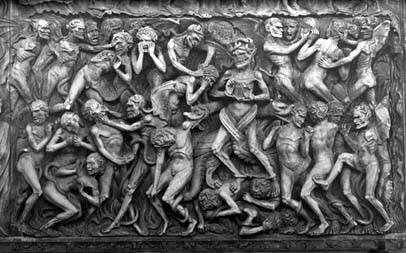
Image: a relief panel showing The Underworld, or Hell. I forget where it is. Such images were used by the church to frighten their illiterate worshippers into obedience.
Tuesday, October 25, 2005

Freeze-drying bodies

British local authorities are struggling to keep pace with demand for burial space and to conform to new rules about emissions from crematoria. 'Green' burial sites, where trees are planted on graves instead of headstones, are few and far between.

The Swedes have found a new way to solve the problem - freeze-drying. Bodies are frozen in liquid nitrogen, and then, in their brittle state, broken into dust that can be buried in a shallow grave. I've heard old gardeners say that when they die they'd like to be buried in their compost heap. Well, now maybe they can.

One of my colleagues emailed recently:

'With British Crematoria ... facing millions of pounds of upgrading to come into line on new emissions limits it might be a good time for them to do a bit of lateral thinking. X at Y Crem told me recently that things are so bad in Z Borough Council they seldom plan anything more than a month ahead and most business is conducted on a "firefighting" basis. I don't think Z Crem will be a pioneer. Might leave the door open for the private sector to have a go.'

Thursday, October 13, 2005

Up in smoke


Up in smoke
Originally uploaded by Sparrows' Friend.
British crematoria are required by law to keep emissions to a minimum. Before we were so fussy about pollution (because the dangers weren’t recognised), bodies were cremated in all sorts of unsuitable outfits, and with all sorts of strange items in the coffins. It’s been known for relatives or friends to try to smuggle alcohol into a coffin - "he liked a little drink" – or to put coins in to pay debts. Nowadays, the coffin, lining and robes must all be made of approved materials, and checks are made that no one’s tried to place anything unsafe or unusual inside.

Cardboard coffins are becoming popular, but staff say they sometimes burn too fast. If the coffin catches fire before the door is closed, the body is exposed.

One of the latest concerns is about pollution from mercury in tooth fillings. They won’t take out your teeth, so they have to try to find other ways to stop it from escaping into the atmosphere.

Friday, September 02, 2005

Mourning sickness

Rosie Boycott, former editor of The Independent, made a TV programme about false grief for Channel Five, shown last week. I was practically cheering when I saw it. In 2002 a Welsh academic, Dr James Thomas, claimed that 'the majority did not mourn for Diana', as the conclusion to his research. Think-tank Civitas published a report in February 2004, claiming that a vocal minority indulge in 'recreational mourning'. It's all very unhealthy. It's also very annoying, because the media, including the BBC, will insist on referring to 'a nation in mourning', or 'a city in mourning', such as when Iraq hostage Ken Bigley was murdered, whenever there's been a tragedy like this. Excuse me - but who asked the 'nation' or the 'city' whether we really were in mourning for someone we never knew? One particularly shocking result of the hysteria over Diana's death was the huge amount of money spent on flowers by members of the public, left to rot in the streets, together with soggy teddy bears and pathetic love notes. More than a million bouquets were left at Kensington Palace, her home. Multiply that by the cost of an average bouquet, and you can see that London florists made a lot of money around the time of the funeral. Imagine how that money could have been used by some cash-strapped charitable organisations, including the ones that Diana supported, such for landmine victims, or AIDS patients.

On the day of Princess Diana's funeral I conducted a wedding ceremony in a small hotel in Suffolk. The couple had been expected to cancel their wedding by some of their silliest friends, although the arrangements had been made for months. They asked me if I thought they should, as they didn't want to appear heartless and uncaring, which they emphatically were not. I said no, they should go ahead. It was strange, driving to the venue, because the roads were so quiet. Hotel guests were glued to the telly in the lounge next door to the wedding room, watching the funeral. They cast disapproving glances in our direction as we trooped through to the reception in the garden. Bloomin' cheek! Only weeks before, the tabloid press had been depicting Diana as a floozy, out gallivanting with her 'boyfriend', the Fayed playboy. Now they were making out she was some sort of saint.

A year after the death, I did a Thought for the Day on local radio, as follows:
I didn't mourn the death of Diana, nor did many other people. How could we? It was all such a waste, and very sad for her family, but we didn't know her. Grief is personal.

Throughout history, humankind has mourned its dead in a variety of ways in accord with the customs of the community. It's different now. Things are less clear. The media, especially television, is a huge influence. There is a lot of confusion. People seem to want to be told what to do, as though there's an etiquette of mourning. Perhaps this is one of the reasons why so many people behaved the way they did a year ago, when crowds lined the streets of London around the palaces and along the route of the funeral procession. Maybe for a few hours those people felt a sense of community, otherwise missing from their lives.

A year ago I was on Radio Suffolk talking about the news of Diana's death with Rachel (the presenter). I said that many people seemed to have lost a sense of proportion. I saw Rachel wince, anticipating a backlash from enraged listeners, but the only calls we had were from people who said they agreed with me but hadn't liked to say so. I resented the way that those of us who didn't identify with the 'we' the commentators kept talking about were discouraged from saying anything at all, even from saying that we felt it was all a bit excessive. Too many people made a virtue out of weeping for Diana. Weeping for her was something you did or didn't do, but no one should have been made to feel that if they had no tears they should apologise for it.

Grief, the genuine article, affects everyone differently. Some go quiet. Some weep. Some get angry. Some want to be alone. Some want to be with others. Some do all these things. The situation changes daily. Grief affects us emotionally and physically. Some people, bereaved for the first time, are shocked by how little control they have over it. If you loved someone, even if you didn't always like him or her, grief is the very natural consequence of losing them. And it's personal - —very, very personal.

So if you feel there must be something wrong with you because you haven’t been swept away on a tide of popular emotion, I can assure you there isn't. Many other people feel like you, but just don't like to say so. As Shakespeare wrote:

... to thine own self be true,
And it must follow as the night the day,
Thou canst not then be false to any man.
25 October - update

A Story from the Telegraph:
A passer-by saw what he or she thought was a dead human foetus in a Liverpool alleyway, and after a few days the area was cluttered with the usual soggy teddy bears, dead flowers and mawkish messages. It turned out to be a dead chicken, the police said yesterday, not a human being.