Saturday, April 11, 2009
Mass mourning
Would you want to share the funeral of someone you loved with lots of other families, while a bunch of priests went on about God and said nothing about the person you'd lost? Rows of coffins, plenty of priestly platitudes, a papal message about feeling "spiritually present", but no memories, no affectionate tributes. No. Me neither.


Thursday, April 02, 2009
No memorabilia

I was talking about soggy teddy bears, wind chimes, plastic flowers, windmills, toys, and football shirts with one of the Ipswich cemetery staff, and he said he thought it began after the Hillsborough disaster, when fans left scarves and flowers at the football club gates.
I've previously written about the waste of money when Diana died, and London's streets were full of dead flowers and stuffed toys.
This photo's on Flickr, where a contact wrote, "Having seen the hideous stuff in Bury St Edmunds Crematorium I'm not surprised. I used to think vicars were being snobbish in their limitations over graves; Bury's gardens of remembrance have put me clear on that."
It's all so tacky. Leaving flowers on a grave has been enough, until recently, to signify that someone is missed, and that his or her nearest and dearest are keeping his or her memory alive. What does a pile of tat say about someone? Nothing, but it does say a lot about how people who struggle to express their loss will imitate one another without really thinking about it. It's what Richard Dawkins calls a "meme", like the fashion for wearing baseball caps back to front. I don't know how long this fashion will last, but I hope it's not long.
Wednesday, March 25, 2009
Last word (for now) on Jade
 I've already written about Jade Goody. Now Johann Hari's written about her too. I felt inclined to cheer when I read it.
Saturday, March 07, 2009
Be prepared
I shouldn't really criticise, as I'm not the most organised person you could meet, but it's so inconsiderate to pop your clogs and leave your nearest and dearest to hunt the will, bank statements, insurance policies, etc. The period immediately after a death is difficult enough, without all the hassle of trying to find things that have been carefully hidden away and no one has a clue where to look for them.
Even if you do nothing else in anticipation of your demise (and most people would rather not think about it, I know), let whoever will have to deal with the practicalities know where you keep your important papers.
The most recent funeral I conducted was for a bachelor who died suddenly, alone at home. His family had no idea where he kept everything. I expect they're still sorting through his stuff. When there are drawers full of old letters, you can't just chuck them out, in case there's something important in there.
When my mother died, it took me days to find her jewellery. She'd wrapped individual pieces in tissue paper and put it all in a supermarket carrier bag hanging from a hook on the back of her bedroom door. I suppose her reasoning was that it would be the last place a burglar would look. I almost threw it out, thinking it was rubbish, after days of sorting through over seventy years' worth of stuff.
Make a will. Don't wait until you're past retirement age. It's especially important when you're married or just living together, and essential when you have children. You may not have any money, but there may be insurance money as a result of your death as a result of accident or illness. You can appoint a guardian or guardians for your children, so that people you trust will be responsible for caring for them if you die. Will you want a brother with a rather casual approach to health and safety to look after them, or a close female friend who won't let them run amok? It's up to you.
However, there's not much point making a will if no one knows about it, or where it is. So tell someone! Then you can get on with the business of living, and need say no more about it.
Tuesday, February 17, 2009
Jade
An interweb friend has been ranting on Facebook about Jade Goody's public death bed scene, or scenes:
So I can't really comment about the Jade Goody and her cancer stories, as I haven't seen any of them, but as she's hired Max Clifford, the media pimp, to manage her deathbed publicity, it's not surprising that she's in the news. The idea, apparently, is to raise as much money as possible from fees to benefit her children, who'll soon be motherless. What they'll make of it, heaven knows, but since Jade's from a dysfunctional family, and these things tend to repeat themselves, I hope they have some sensible people around as they grow up.
My ranty friend opined,
If she'd lived into old age, what would have happened to Jade Goody? She'd probably have been driven out of the limelight by the next gaggle of notorious female celebrities and retired into obscurity. As it is, she'll be remembered as a train wreck of a woman with a reputation for saying the first thing that came into her head and upsetting Shilpa Shetty. There are thousands like her, but she just happened to go on Big Brother and gain a publicist. It's all very sad. She needed a minder, but not Max Clifford. She needed someone to look after her from an early age. Now all she's got is the mawkish attention of the worst sort of media and the people who bother to read or watch what they produce. You get the feeling that they've already been totting up the profits from the sale of her toenail clippings. Whoever's at her bedside when she dies, I hope they're people who genuinely care about her.
X is wondering if he is alone in really not giving a monkey's chuff about Jade Goody and is sick of every bit of exposure it's getting?I'm not sick of it because I haven't seen any of it. I don't watch Big Brother; life's short enough as it is without wasting any on freak shows. I don't usually read newspapers and never read the tabloids, apart from when I'm reviewing them on local radio. I never watch Sky TV. I get my news from the BBC, CNN, and the Guardian and Independent websites. I did get sick of the coverage of Diana's death, when the BBC went on and on about it, and the Queen Mum's death attracted far too much publicity - boring, boring boring! But if you watch rolling news, you'll soon reach saturation point when there's a big story at the top of the list. Switch off. It's easy.
So I can't really comment about the Jade Goody and her cancer stories, as I haven't seen any of them, but as she's hired Max Clifford, the media pimp, to manage her deathbed publicity, it's not surprising that she's in the news. The idea, apparently, is to raise as much money as possible from fees to benefit her children, who'll soon be motherless. What they'll make of it, heaven knows, but since Jade's from a dysfunctional family, and these things tend to repeat themselves, I hope they have some sensible people around as they grow up.
My ranty friend opined,
Take Kylie. Quiet dignity, utter poise, grace and complete humility. Compare that to the Jade Goody Media Express. Kylie inspired more women than Jade EVER could.Maybe, but Kylie's been in show business since childhood. She's used to publicity. She's a wealthy woman without kids who isn't desperate to leave money to her family. Jade may not have inspired anyone, but the fact that she's got terminal cancer in her twenties has already prompted more young women to get checked for cervical cancer, probably saving lives. Many more young women are at risk nowadays, due to their sexual activitity from an early age. Dignity, poise and grace? Drunkeness, lust and risk-taking; the sort of thing that poor silly Jade's well-known for.
If she'd lived into old age, what would have happened to Jade Goody? She'd probably have been driven out of the limelight by the next gaggle of notorious female celebrities and retired into obscurity. As it is, she'll be remembered as a train wreck of a woman with a reputation for saying the first thing that came into her head and upsetting Shilpa Shetty. There are thousands like her, but she just happened to go on Big Brother and gain a publicist. It's all very sad. She needed a minder, but not Max Clifford. She needed someone to look after her from an early age. Now all she's got is the mawkish attention of the worst sort of media and the people who bother to read or watch what they produce. You get the feeling that they've already been totting up the profits from the sale of her toenail clippings. Whoever's at her bedside when she dies, I hope they're people who genuinely care about her.
Thursday, January 22, 2009
Cremains
 In 1874, Sir Henry Thompson, Bart., FRCS, Surgeon to Queen Victoria, founded the Cremation Society of Great Britain, having written, "it was becoming a necessary sanitary precaution against the propagation of disease among a population daily growing larger in relation to the area it occupied". Municipal cemeteries were filling fast, and cremation was introduced to deal with the problem of disposal. It wasn't popular with the church to begin with, maybe because it associated the fire of the furnace with the fires of hell, but as the practice gained popularity with the general public, the clergy changed its tune.
I believe that we British cremated more of our dead than any other nation apart from the Japanese, who don't have a lot of space for internments. This is probably still true. I think most people prefer cremation to burial because it's all done behind closed doors and they don't have to deal with the messy aspects of disposal, like mud and earth. But as the population's increased, funerals have become more elaborate, and a majority of families choose to remove cremains (which are bone fragments, ground up) from crematoria, instead of leaving them to be buried or scattered in the "gardens of rest", the country's being liberally dusted with bone meal. It might do some plants good (though blood and bone meal used to attract our dogs' attention), but it's not the sort of stuff you want to scatter everywhere, willy-nilly.
When a close relative died the other year, her ashes were divided up between several people and places. I'm not sure how many portions there were, but one lot was scattered in Cornwall, another in Norfolk, and there's a little pot sitting on a shelf at home because I haven't done anything with it. It was suggested that because she enjoyed sitting in my garden, I could scatter my portion there. I don't know how the ashes were divided; whether they were weighed in equal portions or if it was a guestimate. It's irrational, I know, but I don't like the idea of dividing people up like this. It doesn't matter to her, of course, but why spread her about like that? I didn't ask for a share but hadn't the heart to refuse. Once upon a time, people dreaded being cut up or otherwise divided, for fear of being denied access to heaven without all their parts. That's not how I feel, but it still seems unnecessarily fussy to mess about with people's ashes.
Like most people, I never used to give the matter much thought. It's become popular to scatter ashes, whether all at once or in portions, in places associated with the dead person. I suppose it's quite romantic, to imagine that he or she will become a part of a place that he or she liked, or where something special happened. But it's irrational, as most of our reactions to death are, and so many people are doing it that it's causing a pollution problem, and is being restricted. I can imagine some bereaved people, determined to ignore restrictions, shuffling around beauty spots with ashes dribbling from the bottom of their trousers, like the men in The Great Escape who had to get rid of the earth from their tunnels without the guards seeing them.
A retired RAF officer I know told me about an airman who requested that his ashes be scattered from the cockpit of a plane. Apparently they blew straight in again and had to swept up with a dustpan and brush when the plane landed.
The lover of a woman who died years ago had to keep his loss a secret, as he was a married Catholic and his family knew nothing about the affair. For almost a year after the woman died, he used to write to me about her, as he had no one else he could talk to. He showed me photos of a secluded place in the Suffolk countryside where they used to meet, and where he scattered her ashes, so he could "feel close to her". After a year, he wrote that he thought he could manage, and I never heard from him again. I wonder how often he visited the spot where he'd left her, and whether it stayed as he remembered it, or if it had been sold to a developer and was covered with semi-detached houses - or, worse still, industrial units.
As an increasing proportion of the population becomes obese, cremators that can cope with big bodies are in demand. Fat people from our area have had to be taken miles away for cremation because none of the local cremators are big enough. Then there's the problem of mercury pollution, from tooth fillings. A new building to house equipment that will deal with such pollutants is being planned for our local crematorium where it will take up a hefty proportion of the car park, which is already too small.
One way or another, the disposal of cremated remains is becoming a problem as serious as the one that cremation was designed to solve. It'll be a long time before it's sorted, mainly because there's a general aversion to discussing anything to do with death. Try applying for planning permission for a green burial site, and you'll see what I mean.
If they'll have it, my body's going to the anatomists, who'll bury what's left when they've finished with me. As for my relative's ashes; I'm going to fork her into the flower border in the spring, safe in the knowledge that, since the dog died last summer, she's less likely to be dug up again. As for the dog; her ashes are in a little box, next to her photo and her collar. You see, I said we're irrational about death.
Monday, January 12, 2009
Foggy funeral

The thing about burials is, you never know what to expect weatherwise. Sturdy footwear, thermal underwear and waterproofs are essential in winter.
Sunday, October 05, 2008
It's my life, not God's
 In today's Observer, Catherine Bennett wrote about Debbie Purdy, an MS sufferer who'd like to be able to die at a time she chooses but will need help to do so. She doesn't want her husband to be prosecuted for helping her, which could happen, as the law stands.
Mrs Purdy isn't the first to have fought this battle. Diane Pretty is just one high profile case. She died in May 2002, having lost a legal challenge that would have allowed her husband Brian to help her commit suicide when she deteriorated. She had Motor Neurone Disease, which can result in asphyxia. Her husband is quoted as saying,
"They had trouble getting her comfortable and pain-free until Thursday evening, after which she started to slip into a coma-like state and eventually died.Dignity in Dying (formerly known as the Vountary Euthanasia Society) reports,
"Diane had to go through the one thing she had foreseen and was afraid of - and there was nothing I could do to help."
- The 1996 British Social Attitudes Survey found that 82% of the public believe people suffering from painful, incurable diseases should have the right to ask their doctors for help to die. Every opinion poll since then has produced similar results.
- Support for medically assisted dying is just as high amongst religious people and disabled and elderly people. This is despite the fact that some organisations representing these groups have campaigned against the Assisted Dying for the Terminally Ill Bill.
Painless palliative care isn't all it's claimed to be, mainly by those in the hospice movement, which is dominated by the religious - all the hospices around here are named after saints. And even if it was, shouldn't we be able to say goodbye when we'd like to, rather than waste away without the control of our bodily functions? We nursed my dad at home when he was dying. He was riddled with cancer that had started in his stomach. No one mentioned death in our house, let alone euthanasia. He and my mum were not inclined to talk about it. He had a syringe driver attached to his arm, full of Morphine, so he could self-medicate when the pain got bad. When he was too ill to use it, he had to have frequent injections. The toxins flowing around his body from the drugs and his enlarged, diseased liver, made him delusional. He was twitchy and agitated. While he could still find the strength to get out of bed, he somehow managed to find his way downstairs and into the street, looking for someone to "take me home", while mum slept in the next room. After that, she was never left alone with him. When he no longer had the strength to get up, he lay in bed with his fingers clawing at the bedclothes, mumbling about the nightmares he was having. One day, I called the doctor to ask him to come and sedate Dad. While Mum and my sister were downstairs, the doctor stood with a syringe full of Valium and said, "You know what might happen if I give him all of this on top of the Morphine, don't you?" "Yes," I said, "go ahead." Dad's breathing grew more shallow and we thought that was it, but the stubborn old bugger didn't die for another fortnight. No, I didn't ask the doctor to kill him, but we both knew that he might die. If it has been me in that bed, in that state, I'd have wanted to die. Dad was locked in a nightmare, and couldn't wake up.
I've lost count of the number of times that I've had to take a sick animal to the vet for euthanasia. The most recent time was when Wizzy collapsed one Sunday at the end of July, and was clearly in distress. She was seventeen and probably had an undiagnosed tumour that caused a sudden bleed. By the time a syringe had been emptied into a vein, she was already on the way out. The body goes limp; the breathing stops; the heart slows and stops. That's what I want, if I'm in pain or severe distress and there's no hope of recovery. How dare anyone tell me that his or her God says it's wrong!
Thursday, September 25, 2008
A serious case of denial
The remains of a baby boy that have been kept in a mortuary for 21 years will be buried on Friday without any relatives present after his family withdrew their consent for the funeral to go ahead.
Christopher Blum's parents have refused to bury their son, who died when he was four months old, because they dispute the cause of his death.
A pathologist named sudden infant death syndrome (Sids) as the cause, but Christopher's parents believe it was linked to a triple vaccination he received hours before his death.
Enfield council will bury the boy's remains in a north London cemetery whether his family are there or not.
21 years! That little bundle has been stuck at the back of a freezer all that time, because his father wouldn't accept the results of the post mortem examinations. After so long, the father's refusal to go ahead with the funeral seems more to do with his resentment towards Enfield council than with a realistic expectation of new forensic evidence. It's very sad, but that man needs to see a shrink.
Friday, September 12, 2008
Behind the scenes

I took this photo at a nearby crematorium. There's a one-way mirror at the back of the chapel. On the other side is the vestry, where the chapel attendant can hear and see what's going on, play the music system when required, and get ready to tidy up at the end of a ceremony. The mourners can't hear anything from the vestry. The platform is because the mirror is high up for the best view. You can see more of my death-related photos on Flickr.
On the Guardian website, there's a collection of photographs taken by Laura Peters behind the scenes at mortuaries, funeral parlours and crematoria for her exhibition, Behind the Last Closed Door.
You can see some of the sort of things she photographed at one of Ipswich Crematoria's open days. There's a 360° panorama of the business side of its chapels on the BBC Suffolk website.
Wednesday, September 10, 2008
Sticky carpet situations, and other messes
"Sticky carpet situations" was how a housing officer I used to know described some of the homes that she was required to visit. I knew exactly what she meant.
Sticky carpet situations are where your shoes make a sort of sucking noise as you walk in, as the soles peel off the carpet with each footstep. When invited to take a seat, you look around for an un-upholstered chair without any wet patches or obvious stains. I have recklessly sat on a settee, the only available place to sit (apart from a sticky carpet), and found that when I arose, my rear was damp, and it wasn't me.
In such homes, I usually decline a drink. "Tea?" "No thanks," I'll say, imagining the mug might have been cleaned, if at all, with a cloth and some spit. They remind me of a landlady I had, years ago, as an art student. I lived in a flat above their filthy kitchen, where her emaciated husband, who'd been a prisoner of the Japanese and suffered chronic digestive problems ever since, toyed with the food she served for his dinner, anticipating the frequent trips to the bathroom that would inevitably result. I suspected that her unhygienic cooking methods contributed more to his poor state of health than the Japanese ever had. But I digress.
I've found myself in situations where there's been livestock in the room, and I don't mean dogs and cats and a liberal itch of fleas. One house had a colony of guinea-pigs in a corner of the kitchen, whose squeals interrupted us. Another had a very smelly rabbit hutch, with a very sad-looking rabbit, in the corner.
In sticky carpet situations, the people have lived chaotically, so it's not surprising that the man or woman whose funeral they've been arranging have also lived that way. Some would be funny, if it wasn't so tragic. Imagine the lack of imagination of a family who accepted a top flat in a tower block from the council, knowing that one of them was a chronic depressive who'd attempted suicide several times. Guess how she died. Imagine the sheer stupidity of a man with a girlfriend and two small children who got very drunk, stole a car, crashed it on a busy slip road, and then wandered onto the road to be run over by two large lorries, one after the other. His girlfriend couldn't understand why the funeral director didn't want her to see the body. Imagine visiting a drug dealer whose front door was made of reinforced steel, and being invited to sit on the bed, the only place in the room that wasn't covered with junk. His girlfriend had committed suicide. I could see why she'd have wanted to. Imagine the family of a murder victim who lived in a tiny seaside chalet, where the victim's mother chain-smoked and the victim's small son played on a sticky carpet. The room was dominated by a huge TV and an enormous chip pan, balanced on the edge of a Baby Belling stove. How would that child grow up? Would he be a murderer, like his father? Imagine preparing the funeral for a teenage boy who'd deliberately string a wire between two posts so he could show off on his motorbike by ducking underneath it at speed, only to almost decapitate himself. He was always a laugh, they said. There are people who live dangerously from choice, such as mountaineers, and there are people who just self-destruct. Sometimes they wreck other people's lives too.
When chaotic lives end, I've sometimes got the impression that a fair proportion of the mourners (if there were many mourners) have turned up just to make sure that he or she really is dead and they don't have to deal with the spillage of chaos any more. Sticky carpets are the least of their worries.
Monday, July 07, 2008
"End of Life" care
It means dying with dignity. Today's Woman's Hour had a feature about this, a new Government initiative. Woman's Hour reports that "Over half a million adults die each year in England but the service available can often be patchy, and many people do not die where they would choose to." One contributor referred to people wishing to die at home, with familiar smells (like burnt toast), being slobbered on by the dog. Whatever the quality of your toaster, everyone should have a good death. If they're going to provide the training and resources to make this possible, the initiative's welcome.
Wednesday, May 28, 2008
To be late
 Over the past few weeks I've been reading Alexander McCall Smith's No. 1 Ladies' Detective Agency series of books about the "traditionally-built" Precious Ramotswe in Botswana. Mma Ramotswe refers to her daddy, whose bequest of a herd of cattle allowed her to set up in business, as being "late", meaning dead. Throughout the books, various people are referred to as "late". Not as "the late Mr So-and-So", as British people say, but simply as "late". No one is ever dead or deceased.
There are many euphemisms for death. A favourite of the British is "s/he passed away". Where to? Over the River Styx? To heaven? Descriptions of the latter vary according to your religion, or lack of it. The origin of the saying is biblical, so it's not a phrase I use.
On one online forum, during a discussion of death euphemisms, someone wrote that the reason there are so many of them is that it's the thing that frightens most people, so they prefer not to refer to it directly; to call it by its proper name. Is it healthier to acknowledge death by avoiding euphemisms? Does it soften the trauma of loss to use one that suggests that death isn't the end, something that most people wish were true? When people only have to deal with a few deaths, as they lose members of their family and circle of friends, this convention of kiddology may work, up to a point. Those who deal with death more frequently, especially the nastiness of disease and injury, are more likely to develop a type of humour that others may regard as inappropriate, but they need to preserve their sanity with jokes - just as long as they know when and where it's OK to tell them.
O Death, where is the sting-a-ling-a-ling,
O Grave, thy victoree?
The bells of hell go ting-a-ling-a-ling
For you but not for me.
Anonymous - song from WW1.
Illustration from Wikimedia Commons - Dante and Beatrice gaze upon the highest Heaven; from Gustave Doré's illustrations to the Divine Comedy.
Sunday, May 11, 2008
Cultural attitudes
Attitudes to death, dying and bereavement vary from community to community, country to country. Grief is the same wherever you are, though how it's displayed or perceived varies according to social or cultural conventions, or the lack of them. In Britain, some people make "grieving" a full-time occupation (Queen Victoria did this). It's all part of the victim culture that prevails in affluent Britain. Like "counselling" and post-traumatic stress disorder, this is an alien concept to the majority who live in countries where death and dying through disease, conflict and corruption are everyday occurrences.
Nathan's just written a blog entry about attitudes to death in Cambodia.
Nathan's just written a blog entry about attitudes to death in Cambodia.
For those who don't know me, Nathan's my son.
Thursday, January 24, 2008
Ash cash cowboys
The Church of England is taking steps to ban “ash cash” payments to clergy for taking funerals at churches and crematoria.
Instead, the money will go direct to dioceses. The move will stamp out the “crematoria cowboys”, clergy who supplement meagre or non-existent incomes by conducting dozens of crematorium funerals at £96 a time.
At its meeting next month in Westminster, the General Synod will debate switching the “incumbent’s fee” for pastoral services to a fee payable direct to the diocesan board of finance.
Later in the same report, it says,
Every person in England is legally entitled to a wedding and funeral in the parish in which they live.
I didn't know that. Did you? Not that I'd want to exercise that right.
Anyhow, to get back to these "crematoria cowboys": I did wonder how many of these freelance clergy declare all their income, either to the church or the Inland Revenue. A significant proportion don't, it appears. What the clients might ask is; do they get value for money, wherever it ends up?
Tuesday, January 08, 2008
Heat exchangers at the crematorium
Considering the environmental cost of cremation - despite the Clean Air Act, it still causes pollution and uses fossil fuels - don't you think it's a good idea to reduce the impact by using some of the heat it generates to warm the living? Crematoria can be chilly.
The Daily Mail reported today,
Tameside Council in Greater Manchester is planning to link heat exchangers at Dukinfield Crematorium with its boiler system and hopes to use it to generate electricity through turbines.
Comments about the story are as interesting as the proposal. Most seem to be in favour, with only a minority using words like "sick". Eileen from Herts wrote,
Ughh. Sounds awful to me. I would hate to know the heating was being generated by loved ones [sic] bodies. Deceased or not.
Deceased or not? What does she mean?
The Daily Mail's sub-editor seems ignorant of the purpose of a crematorium. The story's headed,
Crematorium to keep mourners warm by burning bodies of loved ones
which suggests a funeral pyre with relatives standing around, warming their hands. Crematoria don't burn bodies to keep mourners warm, but because it's cheaper than burial and most people prefer it. There was a time when the idea was repellent to most people. It was a practical solution to the problem of overcrowded municipal cemeteries. Lots of people used to think "Ugh!" Some associated cremation with the fires of hell. It only takes a few decades for attitudes to change. Why waste heat?
Wednesday, December 05, 2007
Graham Chapman's eulogy
Friday, November 30, 2007
The end is nigh
 Why write about the death of a pet? Because some of us mourn for them just as we mourn for people.
Poppy is eighteen years old. She was given to me as a pathetic little scrap that had been born in a coal bunker. The mother's owner wouldn't have her cats neutered and when they had kittens she just took them to the vets and asked them to kill them. My cleaner, who was a neighbour of this stupid person, phoned me and said would I take a couple of kittens she'd rescued, until she could rehome them? Someone took the other kitten before she got to me, or I could have ended up with both of them.
Poppy was filthy. She survived having a tape worm, fleas, lice and ear mites. By the time we'd nursed her back to health, Nathan said he didn't want to part with her. She's been run over (her tail was paralysed for about six weeks), had skin cancer (part of an ear had to be amputated), came home one day with a puncture wound in her face, and went missing for a couple of months about two years ago. The photo above, taken not long ago, has been viewed 248 times (to date) and favourited 44 times by cat-lovers on Flickr.com.
Poppy has a sunny disposition, she loves company, and liked to sit beside any visitors and pat them on the arm until they stroked her. Now she's dying. Within the next few weeks, I'll have to make the decision to take her to the vet one last time. Her kidneys are failing and her breath has that tell-tale smell of urine. She sleeps a lot.
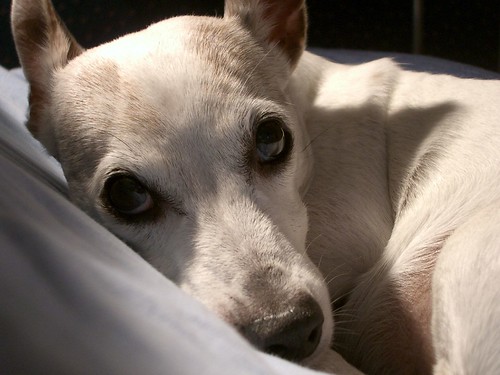
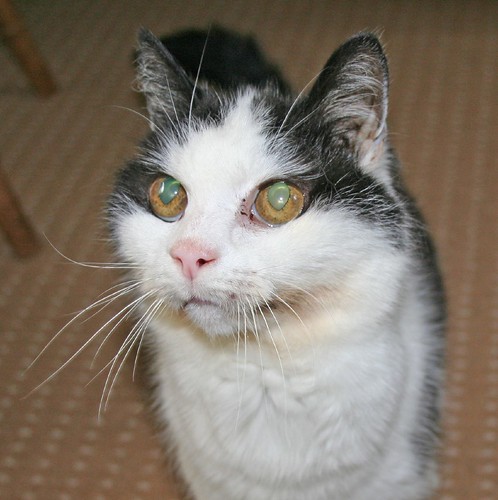 Trouble is, there are two other geriatrics in this house - Wizzy (our Jack Russell), who was sixteen in May, and Barney, who's almost twenty. Before long, I'll lose them all.
Pets are sometimes referred to as "companion animals", which is an accurate description. For many people, particularly disabled and elderly people, they provide companionship that makes all the difference between crippling loneliness and tolerable solitude. Losing a pet can be as devastating for them as losing a close relative - in some cases, more so. I've provided a befriending service for bereaved pet owners through our local vet. They've said they found it hard to talk about their feelings to their friends, whose attitude might be, "It was only a dog!" Their uncomprehending "friends" muddle sentimentalism with grieving. Because pet owners can form bonds with their animals that can be as close as they might form with people, they grieve at the end of an animal's short life; those who don't recognise this betray their own deficiencies. When I was in my teens, my best friend's mum, Stella, gave me some good advice about relationships: "If he doesn't like animals or children, he's a waste of time." I've always regarded people who don't understand animals, or our relationship with them, as being seriously lacking in the empathy department.
For several years now, social workers have recognised that there's often a connection between animal abuse and child abuse; if someone tortures or neglects an animal, he or she is likely to treat his or her children (and partner) badly. Animal cruelty cases can alert social workers to children at risk. It's because of an inability to empathise.
I've always stayed with my pets when they've been "put to sleep", the euphemism for euthanasia, so they'd be reassured by my presence. After the injection, which literally does send them to sleep, they just stop breathing and that's it, over in seconds. It's always been very peaceful. If only we could do the same for people, like my dad, who had to suffer weeks of morphine-induced anxiety at the end of his life as his body rotted away. I've taken other people's pets to the vet because they couldn't face it. Within the next few weeks, I'll have to take Poppy. I'm not looking forward to it.
I like this poem by Gavin Ewart, called "A 14-year-old convalescent cat in the winter" -
I want him to have another living summer,
to lie in the sun and enjoy the douceur de vivre -
because the sun, like the golden rum in a rummer,
is what makes an idle cat un tout petit peu ivre -I want him to lie stretched out, contented,
revelling in the heat, his fur all dry and warm,
an Old Age Pensioner, retired, resented
by no one, and happinesses in a bee-like swarmto settle on him - postponed for another season
that last fated hateful journey to the vet
from which there is no return (and age the reason),
which must come soon - as I cannot forget.
Postscript:
Nathan's reminded me about how different attitudes towards dogs and cats are in countries like Cambodia. He mentioned that someone in Siem Reap had a row with his neighbour, who'd killed and eaten his dog "because he was hungry", while other people in the neighbourhood had pulled out or cut out their dogs' teeth to stop them biting each other during frequent fights - the screams could be heard some distance away. The WSPA reports that there are roughly 480 million stray dogs around the world, many suffering from horrible diseases and painful deaths. My pets live in comparative luxury, costing £1000s for food and vet's bills. Is it ethical to spend so much money on our animals, when so many people go hungry? Perhaps it's not so much the cost, as the fact that too many animals are allowed to breed. Mine weren't.
Monday, November 05, 2007
21st century funerals
It seems that those most "traditional" tradesmen (and a few women), the funeral directors, and the people who work in cemeteries and crematoria, are gradually catching up with modern business practices.
When I began conducting funerals sixteen years ago, emails were unheard of. To confirm a booking, the funeral directors sent you a pre-printed form addressed to "Reverend Sir", and since I was neither, this had to be crossed out and my name substituted. The forms are all different now, but an increasing number of funeral directors confirm the details by email.
It was usual to be paid in cash, with the money (sometimes in a little brown envelope) discreetly pushed into my hand or pocket after the ceremony. One funeral director, a short man who always wore a top hat and tails at funerals, used to put the little envelope into his upturned hat and point it in my direction as he went "Pssst!" and swivelled his eyes from me to the hat, while the mourners were saying their goodbyes at the graveside. Nowadays, a few funeral directors are catching on to the convenience of paying by BACS (bankers' automated clearing services), so the money goes straight from their account to mine. One even wrote to say they won't pay by cash any more and would I prefer cheque or BACS? I wonder how many clergy used to declare all their cash payments?
Then there's the music. The organists have less organ-playing to do these days. An increasing number of people ask for recorded music. Frank Sinatra's "My Way" and Robbie Williams' "Angel" are two of the most popular choices. My heart sinks whenever I hear Celine Dion mentioned, or Bette Midler's "Wind beneath my wings" - neither can hit a note without warbling up to it in an unsteady manner that makes me want to yell "Please! Stop!" Recorded music was all on tapes at one time, and they could be unreliable. One machine in a local crematorium regularly chewed them up. CDs aren't much better, particularly the ones that people have copied on a PC; some crematoria have banned them. Sometimes people will turn up at the funeral with an empty case; they'd been checking the music, and left it in the machine. One local crematorium now uses the Wesley Music System. Music is ordered online and downloaded onto the crematorium's computer, so all I have to do is make sure it's available and it's been ordered. If anything goes wrong with the equipment, it's not my problem.
In the old days, coffins were made by local builders, hence the connection between building firms and funeral services; there are still a few like that around here. Nowadays, they're mass produced. All the funeral directors have to do is assemble them. I believe there's a funeral supermarket in London where you can go and buy your own flat pack coffin. The first time one of my clients asked for a cardboard coffin, and I relayed the request to the funeral director, I heard guffaws of laughter at the other end of the phone. When they realised I wasn't joking, it went quiet. An increasing number of people are choosing cardboard, wicker or bamboo coffins now, especially for green burials. Bamboo is quieter than wicker - it doesn't creak as much.
Maybe one day they'll catch on to the system of freeze-drying bodies, which can then be used as compost. At least one council's already considering it.
There's still one area where the funeral trade isn't up to date; many funeral directors tend to assume that most people will want a Christian funeral, or a pick 'n mix ceremony with a bit of religion thrown in, and they don't fully explain the religion-free, Humanist option. Considering that there are so few of us to provide such ceremonies, maybe that's just as well.
Even fewer people realise that they don't have to have a priest, clergyperson, rabbi, or any sort of professional celebrant to conduct a funeral ceremony. They could do it themselves.
Friday, October 12, 2007
Death by lava lamp
Surely a nominee for a Darwin Award?
24-year-old Philip Quinn was tinkering with a lava lamp at his home in Kent [US]. His girlfriend and his parents became worried when they couldn't find him and couldn't get him to answer his phone.
Claudia and Bill Quinn drove from their home in Auburn to check on their youngest son. They thought maybe he'd just overslept. They were devastated by what they found.
"I looked around the corner and saw his body slumped there in the corner and just couldn't believe what I saw," said Quinn's father.
"There was glass from the kitchen clear to the living room," his mom told us. "They said it appeared that a piece of glass punctured his heart."
Philip, in a fatal act of experimentation, had placed a lava lamp on the kitchen stove. When used properly and heated only by a small lightbulb, 40 watts in most cases, a lava lamp is essentially harmless: a mix of wax or oil and water sealed in a glass bottle with a small air space at the top of the bottle to allow for the liquid to expand under heat.


Subscribe to:
Posts (Atom)